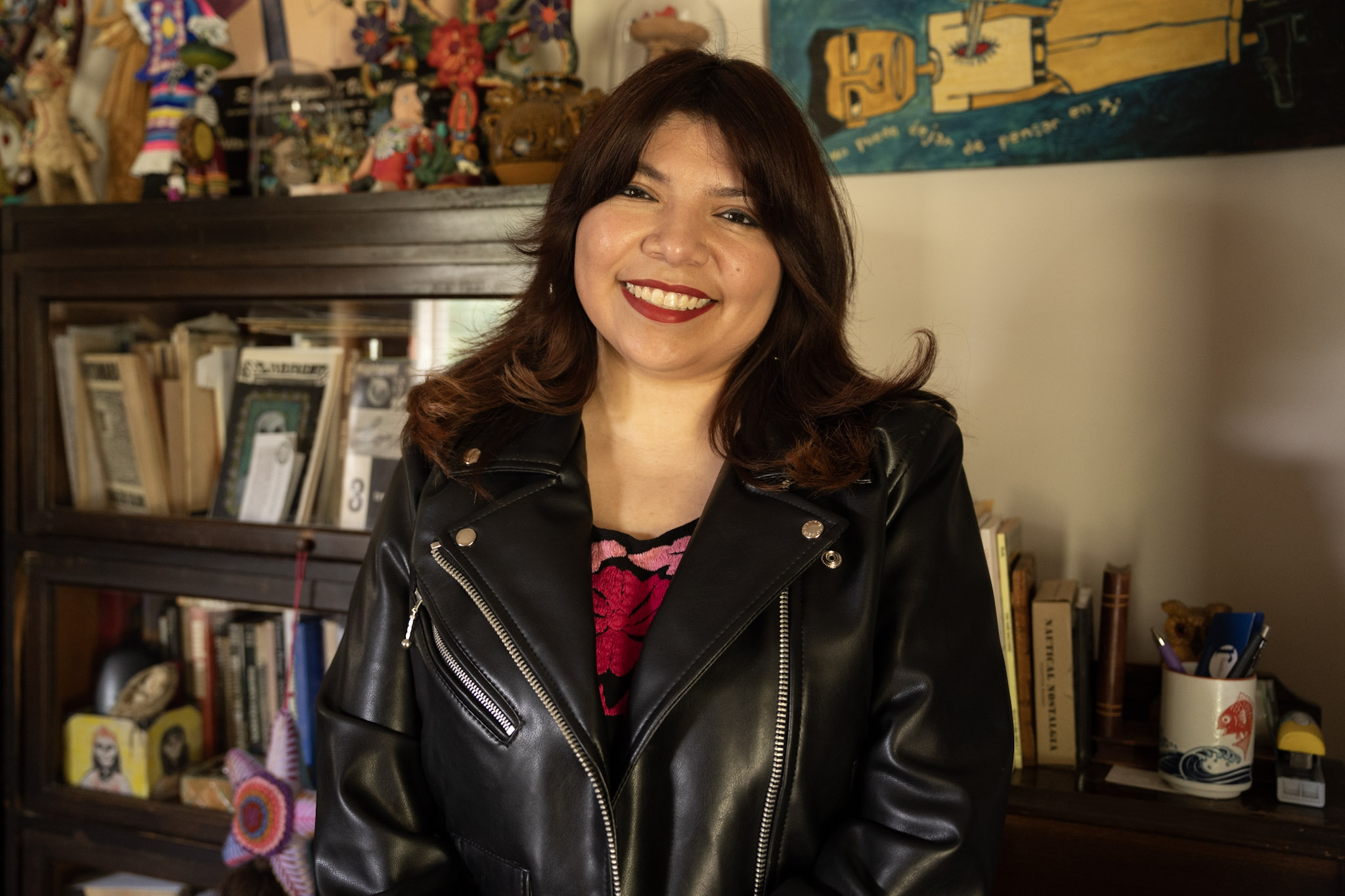
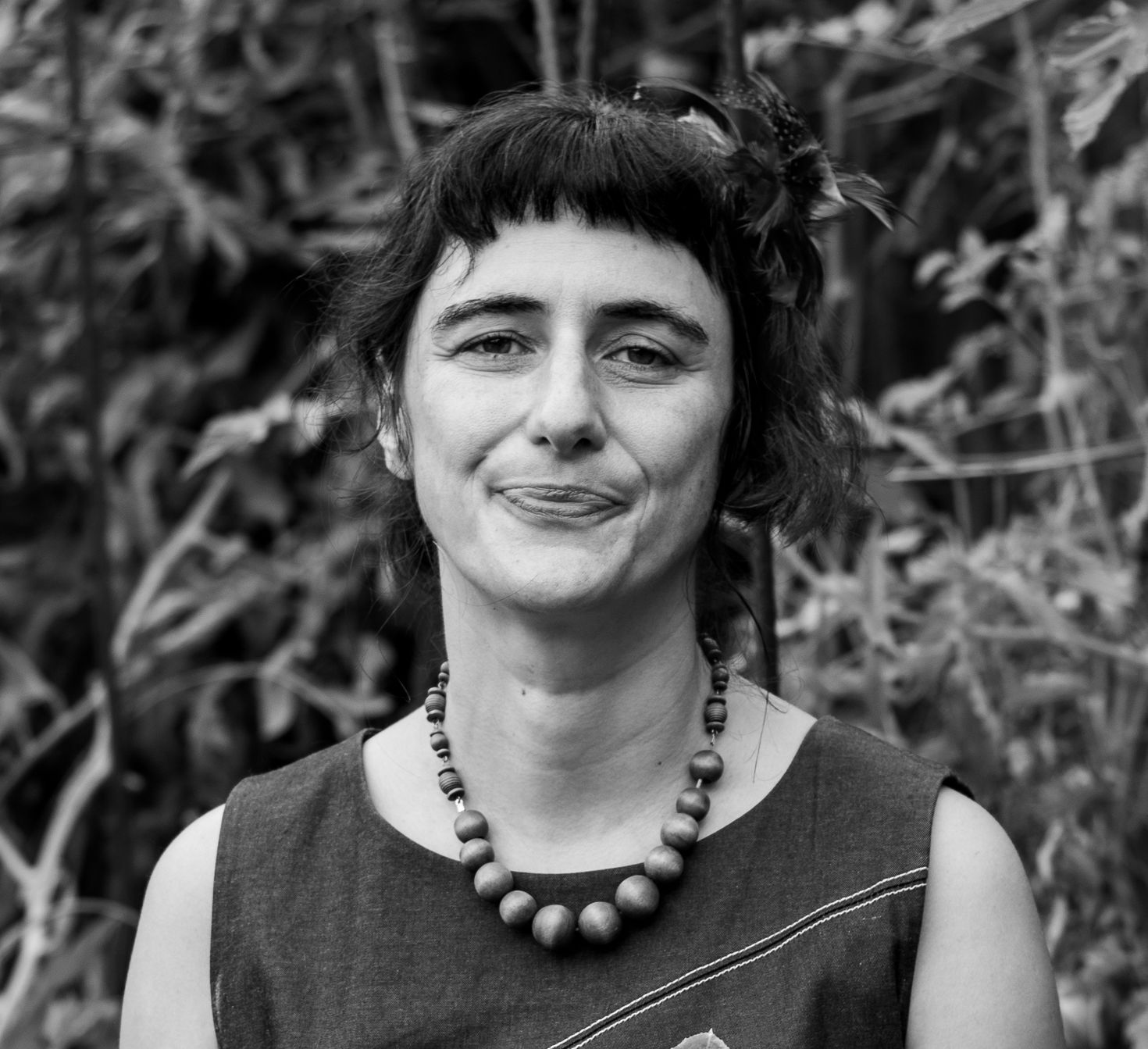
Austin Poetry Review: Congratulations on the publication of ‘Night breaks apart, like pomegranate seeds in my palm.’ We love the long title, it reminds me of Bukowski but thankfully your poetry is so much more profound and female-driven, in terms of content and depth. It is so exciting to see a collection of your work at long last. Could you talk us through the achingly beautiful poem ‘NEELMOHAR IN A SULPHUR SKY,’ in terms of the message you were sharing here? With lines like this:
your sharp movements in space dulled by the thread of the eye
waves, lines, lines—stacked into an ocean
the body collapsed into a fever—
Light like a rod across all being
Aakriti Kuntal: The poem Neelmohar wears blue as an ornament. Blue as the colour of the pious note of an aubade. Blue that stretches like a tarpaulin dream from one edge to another. There is a kind of elasticity to this current that pervades everything. It stretches from the mouth to the sea—a kinetic pearl that is the atom of life. Neelmohar is the tree that wears blue on its sleeves. Blue runs through its thick birches, wrapping everything in a mint delight.
The poem places the poet, the reader, the eye in the body of the tree. The tree carries, like a wave, the enormity of existence. The sweet pulses of life glisten in its arms. It is the scalp of the earth. The feverish tune of life.
This poem is inspired by the Neelmohar tree, where “Neel” means indigo. The poem transitions between states of existence, in which the self is merged with the tree and the smallest units of existence. In this, I touch the membranes of existence as they fold along the self and the tree. The body is mirrored in the expanse of the Neelmohar swaying in the breeze. Everything mirrors everything else. The poem celebrates this. How all life is stitched together by the air that flows like a sneeze—vibrating through everything. Nothing exists in isolation. Everything is an incarnation of perhaps the same unit of energy. In Neelmohar’s grandeur as its birches align with the winds and move inside the substrate of the sky, I am filled with reverence.
These specific lines describe how the tree’s branches sway to the rhythms of the air and clouds, which cannot be fully captured or traced by the inept eye. Hence, dulled by the thread of the eye. The tree’s movements resemble a stack of waves, flooding the being like a seamless ocean. The body both figuratively and literally collapses into a fever, dispenses all material life, and dissolves into a lacking suspension. I have always been fascinated by light. How it stitches everything together visually, being the fabric of time. Here, too, light runs across the being, across existence, across the minutiae and expanse of being, the element that distils and stitches everything.
APR: We know you’re uncomfortable with praise, so let us avoid the obvious and state simply; when we first read your poetry Aakriti, we didn’t know how someone could write the way you do. It isn’t simply surrealism or intense creativity. With some surrealism there’s no clear meaning. Your work possesses both. The sheer beauty of your language alongside this surrealist structure, feels intoxicating, it’s more than beautiful, it stirs something within and that’s rare. Poetry can be so self-conscious. You appear to write almost in a trance at times. We’ve noticed quite a few Indian writers are especially talented at more phantasmagoric poetry than other nationalities, is there a reason for this? Have you always written this way or did it become your poetic style over time?
AK: I guess writing is predominantly a spontaneous activity for me. There is this overwhelming urge, or itch, to create, and then there is a current that consumes one. I feel there is always festering and marinating going on—when we are observing life or simply responding to it. Then perhaps, a trigger, an image or a line, like a matchstick, commences this unravelling. This conflagration of being can feel like a trance. However, I’m not an expert on what a trance is, or for that matter, why Indian writers have a propensity for this kind of writing.
When I first began writing, it felt like I was conversing with the universal energy. There was a sweet depletion of being as this happened. My own thoughts finally leaving, and this scooped-out shape of my being was lighter, vibrant. I was immediately drawn to the surrealist style—André Breton and Baudelaire’s works. Among other poets that influenced me were Mina Loy and Rainer Maria Rilke. I am drawn to the strange and how the strange suddenly becomes familiar. The dissociated body, its many selves arranged as in a jigsaw puzzle, is an archetype that reoccurs. The body acts as a portal through whose many plasticine currents, sensations, and tensions, one could dive into the fluid mechanics of the inner self.
I feel poetry is where language elopes into a cloud. There is a dreamy state—a kind of transition into this liminal space that witnesses the blue light of existence. What does it mean to write surreal poetry? I guess surrealism is about leaking. The mind leaks. The body leaks. The odours run like a pair of deer in a haze, like blue cheese and neem oil. The body arrived at a threshold, like an electron jumping orbits, and the unleashed colours are like language. Language arrives in cohesion with thoughts and feelings, but surpasses the small frame of human processes. It anchors the universal to the human, the cosmic to the planetary.
I also recently read about spatial cognition, which talks about how thinking isn’t only in the mind. “Even reasoning is one step after another. Is it spatial/ temporal?” The body’s language precedes that of any language formed by the mind. I feel there is an instinct that guides us there. In poetry, too, I work with intuition and instinct. The body’s language seems to be a primordial one, an innate one. There are messages of the body that we are adept at understanding. Poetry that uses the body as its scope channelises this. Language surpassing language.
APR: In an earlier poem ‘Frame’ you write:
I slide my fingers
through the vertebrae of fixated air
Conceive a frame and fall through
We thought immediately of your physical struggles with health, which seemed ratified by the subsequent lines:
They hang, my paper boat thighs
they hang in mid-air paralysis
It reminds us of Frida Kahlo’s art, in that she painted her infirmity as much as her interior and exterior soul and life. Confined one could argue, by her physical limitations owing to her terrible accident and subsequent illnesses. We know you struggle also and wonder, how much of what you experience physically, influences or colors what you choose to write about? And did you write using surrealism to avoid the more staid and obvious poetry describing physical illness in a literal way?
AK: There is a way that the body inadvertently enters my work. I think I’m a very introverted person, and a lot of the colour of my being, my pain, slides into my poems. The body acts as an unconscious landscape in which the strokes are laid. I don’t always do it intentionally, but it has a way of rushing in. Perhaps, the body’s way of being heard. The dilations and sensitivities, the rhythms and tumours of the body allow for a language that is dissociative, surreal. Instead of narration, I felt more comfortable with this style. It was a veil and a mirror. The myth of the body can only be measured in the nudity of the self. The self is bare and bare.
Any kind of physical limitation or illness alters the lens through which you experience the world. There is a dizziness that accompanies the lisp of language. However, there is also a kind of yellow tungsten light that gives a new shape to everything. When even basic things are taken from you, you learn to value what you have. There is an urgency and a drama that even air possesses. The breath tunnelling through your nostrils is no less than a Bougainvillea branching along the shape of your cheekbones. The taste of food is the primal elixir of life. At the same time, there is the powdery churn of pills, their chalk-like dispersion in the epiglottis. The body is an architect. There is a romance between elements and life forms. There is a romance between molecules. This breath and span of existence cuts across the laced heart and becomes an inevitable part of how one views the world.
I lean towards more obscure imagery. I move as language within me propels me to. I like to sway in her carved universe. I feel poetry should take a leap. It should pounce and prowl, purr and hide. If not poetry, where else does language froth and bewilder itself? Surrealism has its paws in the eclectic universe, moving and shifting with the currents of the unconscious mind. The drift of the subconscious tethered, like a dream caught on a kite.
Art is our entanglement with all of reality (Perhaps, even Iota?). When I create, I dissolve into a non-entity, I am sparks, I am barely and acutely human.
APR: In ‘Murky’ you ask one of your incredible questions within the poem:
God, did you pinch my very tongue and scream?
Are you standing, all lather,
in grandma’s petticoat?
Are you the rain?
The marble floor?
My balcony is a ball of black seeds.
It is this combination of acute visuality alongside the creative interpretation of that visuality and what you choose to focus on or introduce (balconies becoming balls of black seeds) that really transports the reader INTO your interior world (questioning God, asking if they are past-present-future, neither, all) as well as a universal world (and universal questions). One of your greatest abilities as a writer is how you can coax all that in just ONE poem. How do you balance a poem when you’re writing it? Where you are able to bring all those considerations into just a few lines?
AK: A: I think when writing, a lot of the instances of the self are like wheels in motion. One has to sort of take a back seat and allow these wheels to unwind. The images are dissociated in the beginning. However, very soon, a rhythm appears; thoughts bridge and overlap, and an arc forms. I mostly just vomit all that I’m feeling, and I have my tentacles swarming in more than one dimension almost always. I feel my brain is very clogged. It is always swarming with thoughts, notions, and peculiarities. Occasionally, it is completely barren, absorbing each bend of light and colour around. Both of these states transmute into art.
A poem manifests as a kind of osmosis. The osmosis between the watery selves. The threshold between the different parts of the selves stretches, becomes a taut dupatta, and develops holes. From these holes, thoughts wear jackets and coats and arrive together. A poem is like a tea party where your thoughts are guests and hosts. How does one include all these thoughts in one poem? One doesn’t force them. The colours of the being simply leak, and the sheet is changed.
I have a poem in the book (The Trajectory of a Poem) in which I discuss how a poem follows the Heisenberg Uncertainty Principle. One wishes to mark its location, but it continually evades one. I think the spectacles and events of a poem unfold in us as we move along in life. Moments we absorb, things we observe, particles and fish swimming in the aquarium of our being. It is when the poem is written that they all flow forward. A lot is simply transmuting into words later at the event of a poem. I feel the mind can be like a sponge, absorbing everything, and the imprint of it is the poem.
APR: In the collection, you have a poem called ‘ORIGAMI DREAM’ where you talk of dreaming and in that dream:
I’m made of paper. A paper folding and
unfolding, folding, unfolding. There is a scissor in my mouth
and a cavity in my large stomach. I am a dream, a dream of
paper. I’m almost done. I do not exist. I’m so thin I could
compel myself into non-existence.
We read this as a polemic to some extent, of how you experience life at times, and found it deeply moving to consider (your consideration) of the physical self-alongside the spirit self and perhaps, the dreaming self. When you write, you take into accounts multiple directions, personas, elements of the same, as if you’re able to break a kaleidoscope down into its various parts. It’s this, that marks you as a surrealist poet but unlike other surrealist poets I read, who often appear to be writing in this style to hide meaning, we feel your surrealism reveals meaning. What do you say to this interpretation?
AK: It is an interesting interpretation. This poem’s larger-than-life aspiration is to become weightless. This poem accesses the expanse of the human condition. Its fervent dream to experience freedom. There is a bewildered night that roams in the aroma of the body. It is unfettered. The poem wants to experience this true weightlessness. All the parts of the body—the physical, the spiritual, the mental want to experience a dispersion. The atoms of the body strewn. The atoms of the body copulating with the bricks of the living world. The atoms of the body rising like foam into the sheet of the sky. I like to employ surrealism as a tool for the self to navigate its boundaries, to arrive at the excesses and shrinkage. The dissociated body, roams in hues, not being pinned down easily to any one interpretation, any easy meaning.
The taut contours of rational thinking sometimes impede the train of thought. The brain thinks in associated images. There is the subconscious waiting to be inverted onto the paper. Surrealism is not merely the bridge but the very expanse of the unconscious finding its own language, its own projection in the animated universe. We only have theories on how the human mind works. Its smallest, purest unit—thought, still eludes us. How do thoughts cling together? How do they dissociate? How does memory make the saline in which everything floats? Does memory alter reality as perceived? There is biochemistry, and there is linguistics. We are grasping at the frayed edges of our own being. When allowing surrealism to guide you, you are giving the subconscious a boat to glide on.
I sometimes like to listen to classical music and dissolve into a syrupy state. Some of the artists I especially listened to while writing some poems in this book are Max Richter, Vivaldi, and Philip Glass.
I neither intended to conceal meaning with this or reveal. I think it is for the reader to traverse as they like. I feel readers who have experienced similar circumstances in life as I resonate quickly with the work.
APR: In your poem ‘THE-TONGUE-IS-A-PINK-CELLO’ you write: “I was a djinn, / I didn’t belong to this planet.” Which feels ‘telling’ when set in a hospital setting. This is your first collection of poetry, yet you’ve been writing a long time and established a large and committed fanbase. Why didn’t you put a book together earlier? How do you feel about having done so now? Does it change anything? Is it challenging to plan in terms of your writing when your health isn’t reliable?
AK: Yes, it can be challenging. There is a climate of uncertainty and sometimes unexpected heaviness. I have been working on this manuscript for some years and could have put it out earlier, but I guess it didn’t feel whole at the time. I can be a perfectionist sometimes and tend to overthink. It has undergone edits and restructuring over the years. I have also abandoned some ideas I had for it.
However, I’m very glad it is out and now in readers’ palms. It is a strange feeling for sure. I think a part of me has still not accepted that this happened. It will take a while to sink in. I think a core part of you, a part that you yourself don’t always fully comprehend, is open to readers around the world. This takes a while to absorb. A book is a landscape of the poet’s inner subconscious. The reader is able to experience their delights, their woes. A book is a poet giving access to their inner city. This measure of sharing is an act of vulnerability.
APR: One of the most shockingly honest poems ‘DEBT’ in your collection says:
What is it that flows between two hands but never dies? / What
is this? / This unspeakable word on the cliff of my throat/ this/
this which has been felt before/ I’ve known it/ this glorious
madness of no end/ of only living/ this sickness of love that
bursts through the two vertical halves of the body/ What is this
but the ambition of life? / Bouncing between the same two
moments/ birth and death/ never finding its answer/
We were quite speechless reading this poem, because we felt it got to the very purpose of things, revealing a truth rarely touched upon. Again, we might be reducing its meaning by considering your illness because it’s relatable on multiple levels, not least a wider context of the meaning of life.
AK: Yes, I think this poem ties the strings of the personal to the universal. A sort of convoluted ribbon.
This poem was born from ekphrasis. The image was of a river. The sight of a river made me feel as if the river was stretched between the glaciers and the seas like a rubber band for eternity. It flowed ceaselessly between the same two ends. As I was in the middle of writing this poem, it dawned upon me that I do not understand the purpose of life. There is an inherent madness to the architecture of things. It feels like the individual does not matter in the game of numbers. What is life? What grants the quality of being alive to a thing? This molecule of life is a fringe net that extends between the two points of birth and death. This poem explores this incessant need of life to arrive at the altar of death. What is life seeking? “Life as the abacus in which the beads wear various guises. Life as the element that imbues us all. Life as an elemental force. Life as the mysterious energy that imbues all living things.” What is it seeking? Why does it truncate in death? Life births and births only to dissolve in death. It felt in a whimsical manner that life owed a kind of debt to death, a debt that death was continually collecting.
APR: What part does madness or altered states of being play in your writing or as your muse? For example, in the poem ARTERY you write:
In madness, reigns the eccentric song of the heart. The dreadful
rose heart, almost terrified, almost smitten with its own severe
palpitation. Its unquenchable need to be, its admirable desire to
not.
Which could be a reference to (slit wrists/impulse to die) or more about literal physical ailments or more of a figurative allegory to existence, ego and longing. There’s a redolent passion within so much of your work that belies the obvious and really inhabits the soul. Talk to us about the messages herewith in?
AK: There is a kind of seizure that grips the lobes of the body. A thick emerald bush where strange organisms purr. Artery does not name but alludes to these waters. These waters that consume the soul. These waters that run along the arteries, swirl in the eyes, and in their frenzy make a carnival of the body.
Do we understand these waters? Perhaps, not. We simply know of their existence. Their existence makes itself known to us in pressure and tensions, in the fringes of the heart, in the terrible lisp of lips.
Art is a reaction to an imperfect world. The poem does not name any malaise but rather alludes to this underlying germ of being that seems to be hissing all the time. This kernel, which does not let the body and mind rest. This atom is an inevitable consequence of being acutely alive.
It speaks of the seizure that entraps one due to existence being its many-edged self. This imperfect apple. These lines address the forked nature of one’s response to this existence. Following Rilke’s adage of beauty and terror, the body reacts along these canals. We cling to life—almost with desperation. Perhaps, because we do not know of the realms that lie outside it. There is so much that is sacred here. At the same time, there is a violence that permeates the soul. This too shreds the heart’s stasis and perhaps invokes a suicidal instinct. However, this could be just simplifying things. The reasons we cling to and abhor life can elude our very core.
APR: Another element of your writing we have long been drawn to is how you are unafraid to focus on challenging subjects. For many, this is avoided, to make their poetry more mainstream or palatable. We sense this is not a consideration for you and as such, you have the quality of a confessional poet, though you are never blatant enough to be called one. It’s an interesting liminal space you’ve carved out, seemingly a genre of your own. In the poem ‘On Nightmares’ you write:
The juice is everywhere, but who can see things when
they spill?
There’s only the smell and the incense of the heart
vomiting into the night. The night has been cut short,
the dream severed.
The dream like an octopus chewing the naked sense
of being.
What strangeness that myth and reality come like
twins?
It takes really thinking of what you’re saying to interpret it. Although we could argue, interpretation isn’t always necessary. What goals do you have for your readership? Do you want them to ‘feel’ what you write more than get mired in the literalism of it? How important is it for their interpretation, if they make one, to be ‘correct’ versus their own version of you?
In the same poem you state:
I am both dead and alive. I wake having swallowed my
own death.
In the dream, I am man, woman, animal and light, all
with a jarring sense of night. The night a mad rider
with red hair.
In this dream, the mind eats the body and spits it to
make the day.
In this dream, I am the vivid strain of fear. I am bright
red and dimming
black. In the dream, I can be anything but this.
This ugliness, these damp sheets. This blindness,
how myth and reality come intertwined. Hard to say
which is which.
We share so much of this poem because it’s jaw-dropping in its visual representation(s) but also there’s such a story-within-a-story and a series of considerations layered atop of the next. You can’t read your work in one sitting, it asks for deeper contemplation, which might mean it’s not for the casual poetry reader, how do you feel about that? And again, how much of this is linked deeply with how you feel upon waking, considering that physical illness is something you’ve had to contend with in ways few can relate to, and at such a young age. To ask a hard final question, what do you think your writing would look like if you hadn’t had those physical struggles?
AK: I think art can be felt before it is understood. In a painting, the colours, the strokes, the shapes permeate us before we are able to interpret it. Personally, I feel a poem enters this liminal space of existence, this scalp of the unconscious mind, the fertile loam of the spirit, even before one can completely understand it. I’m completely open to readers making their own interpretations. I don’t think it needs to be the “correct” one.
I think I understand that my poetry may not be for everyone, and that is okay. I suppose there are all kinds of art and all kinds of audiences for it. A space for everyone, I guess. I feel that streamlining is not how we explore diversity, and art is not a unilateral arrow; it is an all-encompassing, many-toothed mouth.
I like to think of the poet as a seer, the poet as a medium, the poet as the stem through which the saliva of life drips. The poet forges new realms, working with her tiny scalpels to reshape everything— thought, desire, body, space, chairs, air, twigs; the poet as the turbulent blood slipping in and out of the nose of life, chattering about its inane beauty and matchsticks, the poet—stripped.
There is a shadow of the illness on my work. I think I would like to explore other themes one day: time, space, memory, meditation, birds, and so on. It would be interesting for me to discover what other directions my work can take. I tend to hover around death, but I am not blind to the fact that life, too, is brimming with bees and cauliflowers, their sprouting filled with both romance and mathematics.
APR: In ‘THE-FIRST-FACE-IS-A-VALENTINE–RED’ you open with the lines: “What is the reckoning for a stolen life?” Which immediately struck us as a battle cry for your own perspectives. You go on to further this theme with:
The wrist cuts through the atmosphere—
twice in each circle,
reliving its own inexplicable birth
We visually ‘saw’ this as a dance of sorts, a parody, paradox, ironic take on wanting to die, wanting to live, all with the imagery and metaphors of movement. At the same time you bring the reader back to reality:
Death came first
breaking the dam of that certain summer
Which implies a time-and-place that actually occurred as the genesis of this story. Do you find your readership wants to know more about the literalism behind your poems? Or do you encourage them to take the journey with you, without knowing the of you? Do you think you have ever hidden your truths in poetry as a way to be less overt in your need to express yourself? And how important is leaving things ‘dangling’ and not giving all the information, to the tension and addiction of your writing? Finally, who influences right now you as a writer?
AK: There is a time in one’s life when the veils of life become thin. A time when the fat coins of one’s being explode, when thought loses its demeanour. When it becomes a trace without substance. There is an existential crisis that, like a chasm, splits the very being. The poem utters this. This ridge in one’s inner recesses. Death and love arrive wearing each other as guises. They cannot be distinguished. The crumbs of mortality are entwined with love. Love is a seething organism that settles above the eyelashes. It is the stitch that colours everything. Love for every plant and cell. Love that like cream cheese lathers all of existence.
As far as understanding poetry is concerned, I feel poetry can knock at our deepest cells. It has such a familiarity that we can understand without understanding. The words cling to our ears and eyes, dance in our corridors. They reverberate in us and permeate us. All this can happen even without fully understanding a poem. A poem just needs to be felt.
I think it is very much possible that I may have hidden truths in poetry that I didn’t always feel comfortable putting in a poem. That might change any day. I wasn’t very fond of narrative poems earlier and gravitated towards more obscure imagery. I didn’t intentionally withhold information as much as I did what I felt I was moved to.
I think right now, I find Sophie Strand and Gary Barwin’s work very compelling.
Bio:
Aakriti Kuntal is a poet, writer, and multidisciplinary artist whose creative pursuits span literature, visual arts, and experimental film. In addition to poetry and prose, she explores photography, asemic writing, and short experimental films. Her work has appeared in The Night Heron Barks, Rasputin: A Poetry Thread, Luna Luna, Cha: An Asian Literary Journal, and Poetry at Sangam, among others. She is also the author of the chapbook God, Am I Your Eyelid? Her accolades include the Reuel International Prize 2017, shortlisted for the RL Poetry Award 2018, and nomination for the Best of the Net. ‘Night breaks apart, like pomegranate seeds in my palm’ was selected as one of the best poetry books listed by Ms. Magazine of 2025-2026.
3 POEMS
VINES
The black fruits are ripe—
perched in a delicate silence
Clasped fists
the dark centre slowly stirs
sun’s breathless core
The diamond grape,
rich as a dream
a full life in the giant’s mouth,
wholesome and sumptuous
Outside the window,
a dream is running barefoot
naked among the vines
oiling all in its velveteen slime
Outside the window,
an eye is lost
in the eternal static of the white night
Outside the window,
neither father nor mother
neither love nor death
Outside the window,
an invisible fire
The great burden of murmurs,
the faithless bark of heads
Outside the window,
most blatant ecstasy,
a mulberry lake of frigid quiet
Outside the window,
breath, breath
nothing but sheets of wispy breath,
as cold,
as eternal
as the stone’s riverine eye
ABDUCTION
White salt out there,
your whitewashed twigs scowl—
motions unfamiliar
The night is growing thick;
the finger is aflame, a matchstick
It has sworn to shimmer;
the teeth abandon the jaw
and float into the sea,
A jawbone into the sea’s eternity
a poet stood before the ocean
And never returned,
return he did not
And in my cupped eyelid,
a quarter of the moon, the man’s weakening
steps, a half knee dipped in water green,
Arms swinging like ropes,
their jolly—an unfathomable absurdity
Every day the sea washes
his stench from shells and crab skins
Every day the sea washes the sand’s antenna feet
A poet walked into the sea
and never returned
CURRANT
Look here. Look what sits—a single stone. A tiny stone in the middle of the white sands. I see its slimy contours—so black, so distinct as if continuously guarding something. Protecting from some ulterior reality. It has the night stored in its warm belly. The snail scratches on its skin appear as swollen nimbuses. I hold it in my palm and a muddied river meets the eye. A river now entrapped forever in its endless matter ring. Look, here, a tiny stone. Its smooth edges burn as if touching every eternity. I hold it in my palm and my veins flicker under the strange pressure—the stone’s eternal secret. No one has unlocked it. It grows heavy, heavier. Like this body. Locking and choking, long, long dizziness. I take the stone and drop it into the sea. The sea eats the stone. The stone eats the sea.