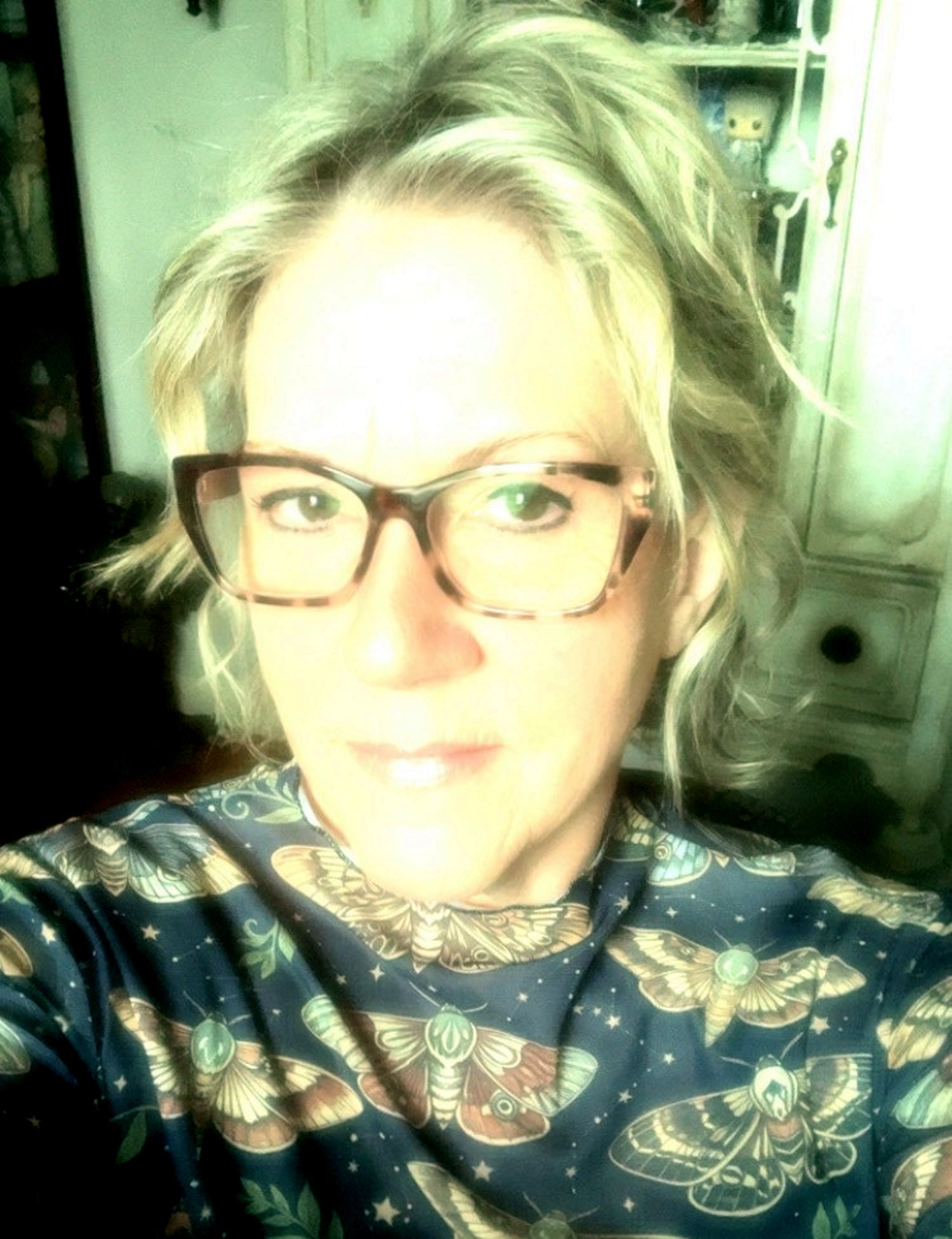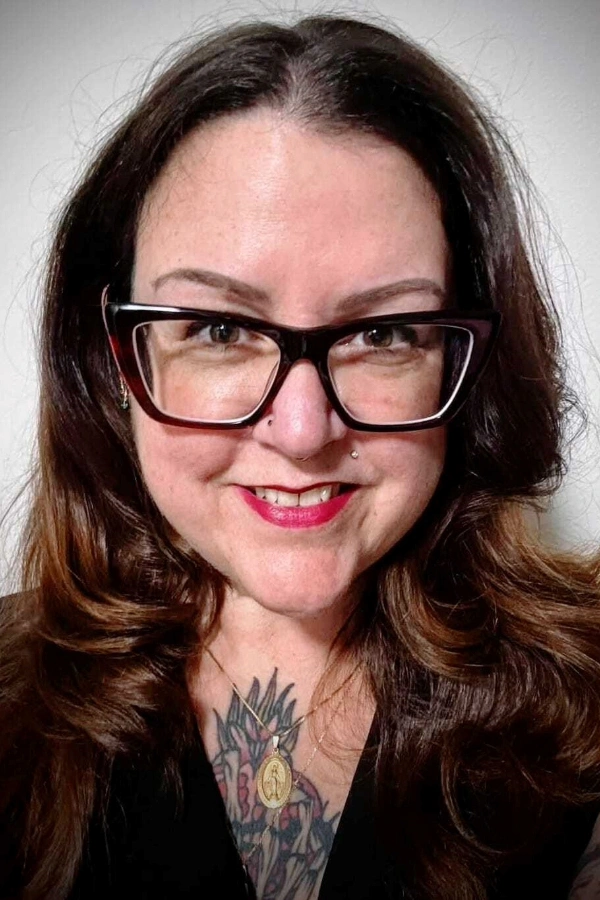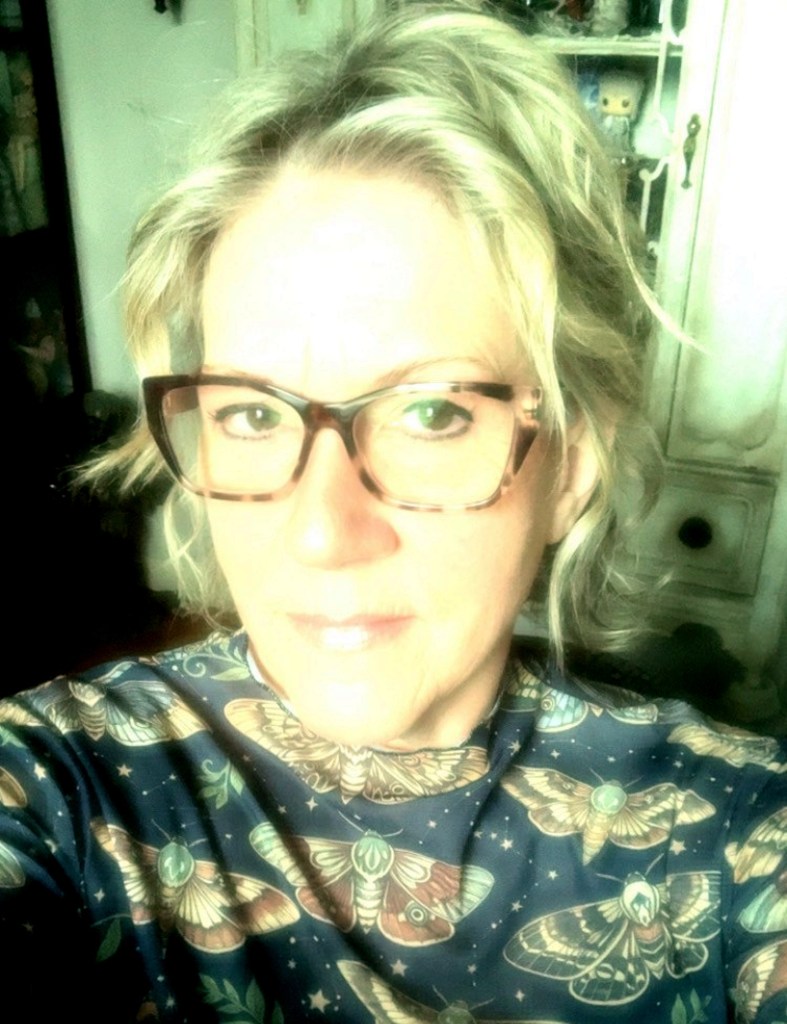
Trisha Leigh Shufelt is a highly prolific author, artist and poet living in New England. She’s the author of: Thundering on the Pink, Inside a Lemon Moon, In Pieces, Penning Paper Moths, Sunder the Silence, Avenoir Poetry & Prose, Unearthing Nevermore-Golden Shovel Poetry Inspired by Edgar Allan Poe, The Ghosts of Nevermore-Poetry & Short Stories Inspired by Edgar Allan Poe, The Ghosts of Winterbourne, and Break & Bloom.
Shufelt has run her own publishing house Art in Soul for 21 years and much like some of her heroines of old, routinely self-publishes, with outstanding quality to the production and art of her books, often utilizing exquisite photography (her own and others) alongside art, to ensure each book is far more than a book. She’s clearly made an art of doing this, in the vein of many literary circles, who forsook main-stream-publishing, which in the case of poetry, makes complete sense.
Shufelt’s influences run widely but she’s particularly fond of: Plath, Woolf, Keats, and Poe, She has written two books with Poe’s specific influence; the Ghosts of Nevermore, 2023 winner of a Saturday Visiter (yes, visiter is spelled that way) Award through the Poe House and Museum of Baltimore, MD. and Unearthing Nevermore-Golden Shovel Poetry.
Her collection Thundering on the Pink Recently released by Kelsay Books on March 28, 2026. Her specialties and areas of interest are: Golden shovel poetry, musicality, allusion, nature, mortality, mourning, nostalgia, depression, and death. Unlike other poets who may have an attachment to gothic and death-related materials, Shufelt is also a breast cancer survivor, so this is personal for her. In addition, she recently lost her mother to Alzheimer’s. We talked with Trisha about how writing helps her deal with anxiety/depression and her previous battles with addiction.
Austin Poetry Review: Trisha, our editor Candice Louisa Daquin has edited three of your more recent collections, and recommended you to us, for your commitment to the poetic form and your alacrity with language and commitment to classical poetry styles. It’s interesting to see you thrive in the social media poetry world, where you post quite classical poems, against a quite disparate mainstream. When you began posting online did you notice the difference between the style and quality of your work versus the bog-standard poetry meme that gets widely shared by people who often don’t read or know poetry well? There is immense value in classical poetry, especially utilizing form and deeper subject matter. How do you navigate your commitment to writing more classically in comparison with the popularist social media poets?
Trisha Leigh Shufelt: This is an excellent question. I’ve always enjoyed classical poetry, although I don’t feel I follow the rules and structure as much as I should. However, there is something about that style of poetry and prose that has always been appealing to me. It’s lyrical, musical, and so much more descriptive. I can get lost in Bronte, Austen, Woolf, and Laurie Lee so easily. I’m a huge fan of purple prose. I lose myself in metaphors. I love them. I don’t think I could write any other way. I wouldn’t enjoy it. With a few exceptions, I don’t see many poets writing in that style, and the ones that do are typically Indie.
Which leads me to writing today verses long ago. While social media has given writers a larger platform, it isn’t without its issues. Thriving in the social media poetry world is often dependent upon timing and mood. As we know, much of it centers on algorithms, which are in constant flux. Some days, I strike gold, but most days are a gamble. Also, social media marketing is pay-to-play, which often goes against my ideals of discovering poets/poetry organically. When I first began posting my poetry, it was on the heels of the instapoet phenomenon. I wasn’t into that style, which feels more like mantra-style poetry. While I do post snippets of my poetry, it’s vastly different in context and subject matter as you noted. I’ve never been one to follow the pack, which has kept me grounded in my own growth as a poet. It keeps me from being lost in a sea of the same, but at the same time, it is difficult to reach a broader audience that wants a short but sweet poem filled with positive themes. I get the need for it. We live in challenging times. Who doesn’t want something cozy and comfortable? I’m not that type of poet. So yes, I definitely noticed a big difference, not only what I was writing about but also the style, which tends toward a more narrative/traditional approach. However, I’m constantly evolving and exploring. One moment, my writing is gothic, and the next, it is steeped in romanticism. I’ve found in speaking with people that poetry is something they either love or do not understand. Like art, poetry is subjective. Appealing to the masses is a great goal to have, but the reality as a Poet is a bit of a crapshoot. I know this sounds like I’m being a Debbie Downer, but since our attention spans are less than that of goldfish, I have to be real by asking why I am doing this. And for me, poetry is about the hidden messages. A poem can be a puzzle. It is why I gravitate to the Poets of yesteryear. I love discovering the secrets behind the ambiguous verse and the deeper meaning behind the metaphors.
APR: You’re not a Debbie Downer at all; anything social-media related is a crapshoot. Totally agree. Reviewers often ask about ‘influences’ to establish the direction you’ve consciously taken as a writer/poet. In your case, however, your influences are wide reaching and varied, I don’t see a single theme obsessing you. Your knowledge of classical poetry leading up to the early confessional poets, especially those female ones, is extensive, and enables you to reference them cleverly in subject and form. Do you feel we owe it to ourselves as poets to inform ourselves of what came before us? Or with this increasing reinvention toward new norms, do you think it’s more of a preference than a necessity? I for one find value in knowing the history of poetry, because it’s a richer canon of writing when you’re speaking from that knowledgebase. Finally, I have to ask … why Sylvia Plath? As a fan, I can give you my answer too, but why do you think she’s so enduring with modern poets and women in particular? What is it, about her message for us?
TLS: I couldn’t agree more. There is much to be gained by exploring the poetic works of the past, language use, form, etc. I’m a voracious poetry reader. I love poets of the past, and they will always be my go-to for inspiration, especially when I find myself getting sloppy or repeating tired themes. Let’s face it, how many times can you write about the jilted relationship or the alcoholic father without it becoming cliche? I do think it is wise to read as much poetry as possible, all different types and styles, to write poetry. One cannot sit down and write mystery novels if one has never read one. Do you have to read past poetsto write good poetry?No, but it can’t hurt. So reading is important. I do love reading Indie and contemporary poetry, too. Some brilliant Indie poets knock my socks off to the point of fangirling over their works. This timeframe we live in is fantastic in the sense that one can connect and correspond with many of them, where once upon a time you could only admire them from afar. For me, I love seeing how others did it then as well as now and what they were writing about. In some respects, especially for women, we are still struggling with the same underlying issues that previous female poets did. We are still screaming inside and longing to be heard. It’s a preference for me, but I also feel it is ingrained in us as women.
As for Sylvia. She is a touchstone poet for me. Her poetry was lyrical and musical. She was descriptive in her imagery. She wrote on difficult subjects but wasn’t afraid to show her own vulnerability, which I strive for in my own work. Her use of sound is particularly inspiring to me. I connect with her as a woman, struggling to find herself and her voice. To be heard and seen, and as someone who suffers from anxiety and depression. She wasn’t afraid to show the world who she was. And as a female poet in a primarily male-dominated genre, this was and continues to be incredibly inspiring. She was a lighthouse amid a storm. I often find I am a storm trying to find my inner lighthouse. Aren’t we all?
APR: Absolutely! That’s definitely one reason Plath has enduring appeal throughout the world. Talk to us about your recently released collections Inside a Lemon Moon and Thundering on the Pink, what drove you to put these together? Thundering is also your first publication through another poetry-press aside your own. What was the thinking/goal behind reaching out for independent publishing? We’re not surprised Kelsay loved this collection, however it’s quite different to your other poetry collections, what were you considering during the writing of Thundering on the Pink? I can’t leave this question without asking, why Golden Shovel as a favored form? What speaks to you about that poetic-device?
TLS: Thundering on the Pink is a looking-glass book exploring life through observations with some Gen X references. There is a bit of wit in it, which I’m not known for, so that was fun. I had hoped to continue with those references in Lemon Moon, but while writing it, my mother’s health rapidly declined, and the poetry that grew from that experience was about processing her death, the loss of childhood, and the comings and goings of people in our lives, etc.
I’m known for self-publishing much of what I create. This doesn’t come from a fear of rejection from mainstream publishers so much as the need to control everything and impatience on my part. When I self-publish, I do all the writing, of course, but I also design everything, work with cover artists, or create my own art, format the book, handle copyright/ISBN, typography, you name it. I’ve worked with other mainstream publishing companies on other non-poetry projects, and the wait for publication is often two years from initial submission. As someone who has been through breast cancer and is fifty-six, I know life is short. It can turn on a dime, and I like to see my work out there and in the hands of those who will appreciate what I’ve done. I was taking a leap of faith by reaching out to Kelsay Books. I did receive wonderful encouragement from a friend to take a chance. But I also needed to release some of that control. I’m a pretty prolific writer, so I was already working on another project. I thought, if this one takes a bit of time before it’s released, I still have other work I can put out there. Under it all, I was also seeking validation of my work as a poet. It’s nice when a publisher sees value in your work and feels it is a fit for them. I have loved working with them.
I stumbled upon the Golden Shovel Poetry form by Terrance Hayes a few years ago, and it just blew me away. I love the idea of paying homage to a beloved poet by creating a new poem around a line from that poet’s work. It’s fun and challenging. If you find yourself stuck, it sparks the creative juices. It’s never failed me. I loved it so much, I wrote Unearthing Nevermore, a golden shovel poetry collection inspired by Edgar Allan Poe’s work. I’d love to put another together, perhaps a collection inspired by Sylvia Plath.
APR: Do it! You describe yourself as a confessional poet though you have also written very non-confessional fiction and poetry throughout your career thus far, which is more narrative, if we were to categorize it. How do you delineate between considering your own life experience, versus writing outside of yourself? In other words, the interior versus exterior? Do you think it’s based more on mood / timing, or do you set out to write on specific subjects? And see where that takes you? How does the addiction-history and battle with anxiety/depression play into your selected subjects when you do write more confessionally? I admire how you can juggle a confessional piece alongside form and beauty of language, I think that’s what elevates a confessional writer, that they’re not just confessing, they’re opening it up to becoming a universal message wrapped in poetry. And of course I must ask, is there a deeper story about moths?
TLS: I believe it was Robert Frost who said, “I have never started a poem yet whose end I knew.” I find this to be true. I am a pantser writer, whether it’s fiction or poetry. I never know where I will end up, but I always find myself in the process. I might have an idea of what I want to write about, but it’s often abstract, i.e., a yellow flower, an empty coffee cup, etc. More often than naught, it’s an observation that I incorporate into a feeling, which evolves into an unhealed wound. Sometimes I have random words on a screen and create a poem around the words. For me, it’s a puzzle. It evolves organically. Sometimes, I look back on what I’ve writ and think, where the hell did that come from? It doesn’t even sound like me. Yet, there is a bit of the interior me in every poem I create, even the ones that are about exterior or abstract observations. In the end, I go wherever the poem takes me. And it is amazing how a collection will end up forming itself. I’ll always find the underlying thread to weave it all together.
I began writing poetry when I was fifteen. Although, it was very moon and June stuff. I also set it aside for over thirty years and didn’t write a thing. I honestly don’t know why, other than not believing in myself. I didn’t give poetry much thought until COVID hit. I’d turned fifty that year and was five years outside of my cancer journey, but I was also dealing with tremendous anxiety and PTSD. I couldn’t get a therapist and was cooped up inside, and drinking. I had also just finished working on the Poe Tarot, where I’d been channeling a good bit of darkness in reading Poe, who is my first poetry love. I have him to thank for motivating me to write poetry again. I quickly realized I had a lot to say, much of which had been buried for over thirty years. I put the wine glass down, and through the pen, I was amazed at what poured out of me, no pun intended. Poetry saved me in many respects because, through it, I could be honest with myself. It did feel a bit like sitting in a confessional, but this time, the world could listen in on what I was saying. And I didn’t mind that so much because I honestly didn’t know anyone who hadn’t battled something, and I feel many can connect to that type of struggle through my poetry.
As for moths, I’ve always loved them. Their beauty is often dismissed because of the butterfly. To me, moths are about exploring the darker side of the self while seeking light. They thrive in the darkness, but it is the light that drives them. I’ve always seen myself in that way. I live for hope and light, but I’m not afraid of the shadows. The shadows are where we find our true selves and heal what is hidden. I find the process painful but ultimately beautiful. I suppose that is why I try to incorporate them as much as I can in my poetry.
APR: We’re so glad you picked up that pen! (Understatement). In your poem ‘October Fog’ you write: “I’ve spent years in dark madness.” This poem is highly evocative and speaks to an outrage of what you formerly settled for, as well as an easing of restrictions through the lines: “discovering I’m happiest / waking inside the chrysalis / of an October fog.” What stands out in your writing is often the word-choices you make, such as ‘chrysalis’ to describe fog. There’s an almost edible quality to your writing at times, whereby you paint worlds so vividly, the meaning is almost secondary. However, this poem is clearly speaking to oppression and renewal. Without revealing painful truths, can you share with us a little of what lies behind these words in terms of your more intimate processing?
TLS: Thank you. I’m also an artist, so I appreciate your observation of painting vivid worlds. I try to do this as much as possible because I want the reader to be absorbed in a landscape. It’s not just words. I want them to experience the poem in relation to the senses. The poem itself isn’t about a specific event but a culmination of events and circumstances processed through hindsight. This is something I often do in my poetry. I like to step back in time and look at circumstances through a present lens. One of my favorite quotes is from Indie Poet Samuel Hurley: “A poem is an epiphany of a truth.” This is something I believe is true of all poems. October Fog is no exception. It’s a truth uncovered after an experience. The first stanza is about the search. Seeking answers to questions of why something is happening, instead of awakening to the unfolding lesson. The answer is often right in front of us, but we are so caught up in blame, guilt, or fear that we can’t see it. We aren’t listening to our internal knowing. It’s an ego block that keeps us in cycles of doubt and trauma.
The second stanza is fear. All the times I said goodbye to something because I feared what might come of it if I said yes and took a chance. Stepping into the unknown brings change and the possibility of failure. What if someone doesn’t like me, etc? It’s kind of like the devil you know scenario. But the devil keeps you in bondage. It’s excuses made while still wanting something, and the ultimate regret that follows when one sees that they were the only thing standing in the way of achieving the goal. Everything we want is on the other side of fear. Perhaps that is why it took me over thirty years to start writing again. And the chrysalis of fog is the liminal space between. It’s a place of peace where one isn’t afraid, where there is opportunity for choice, but ultimately, it is up to us to birth ourselves. I’ll admit I sometimes enjoy the in-between because it feels safe. The space between can feel safe, but is it truly? That is for the reader to surmise.
APR: Reviews often dismiss a female writer who considers death and dying, cancer, anxiety/depression, menopause etc. I think they reduce chosen subjects to cliches by sometimes not finding adequate value in those subjects, especially when from a confessional stance. It feels a bit like gaslighting the choice of subjects, as if by writing about say, Greek or Latin history, we convey ourselves as intellectual poets, but if we write on dying, we’re maudlin, confessional and somehow less? I would argue this is sexism through a patriarchal canon where women writers are marginalized even today, but it’s also patently wrong. If speaking of mythology holds more value than concepts of life and death, we may be missing the point entirely. What do you believe? These subjects feature in your work, often alongside mythological and highly historically informed subjects. Do you feel the urge to share deeper subjects as a rebuke to the idea they hold less value?
TLS: I’ve never really thought about my writing in this kind of way, but I definitely see what you mean. I write about these subjects because they are uncomfortable truths. In general, I find people avoid uncomfortable truths and harsh realities. They’d rather view their life through the filter of their phone, the illusion of AI, or someone else’s perspective, and will do everything possible to avoid unpacking their own baggage. Doing so means we have to face the lies we have told ourselves, the imprints of abuse from others, and how that has shaped who we are and what we believe about ourselves, our fears of aging and dying. We all have shadows. We all die. We all transform. Many experience addiction, anxiety, depression, and illness, but are seldom willing to explore the feelings connected to these subjects because, let’s face it, society still views many of these issues as taboo, or in the case of mental issues, a weakness. And while some tie into our sex, i.e., menopause, I’ve often connected that to the “nature” of all things-the seasons turning, general aging, etc.
I feel this comes from a place of oneness. Yet, as a post-menopausal woman, I know the struggle firsthand. If you are not reproducing, or can’t, you are seen as less than. Women of a certain age are seen as non-sexual. Doctors dismiss you. Breast cancer threw me into early menopause, and all the issues that come with it. It’s a hard truth I’ve had to face, and want others to know they are not alone. I am fascinated by mythology and history, and like to incorporate this into my work. However, I’m not sure how consciously aware I am when writing of purposefully connecting patriarchal marginalization and mythology. I’m sure it comes through on a subconscious level, which is pretty much how all those truths come through in poetry for me. It is certainly something to explore. The subjects are definitely valuable, whether or not the general public sees the value in them. Dialogue is necessary in my humble opinion. Whilst the subjects aren’t always light or trendy, I will always find space for them in my poetry.
APR: In your incredible poem ‘The Poet Must Die’ there is a challenging truth here that few are willing to really harness. You write:
life seeks no exit
yet fears transformation—
paper lantern wings
are stained-glass windows—
holy colors swallowing shadows
in Death’s silent surrender
Does this kind of writing speak to your personal challenges with facing a serious illness and beating it? Does someone who has stared at the possibility of dying, both realize human fragility but also the necessity of fighting? How did your experience with a serious illness influence your worldview when it comes to concepts of life and death? Do you feel you can express this best in poetry? Is poetry perhaps the ideal medium for such considerations, as prose requires too much linearity for something that is clearly not linear in an emotional sense?
TLS: I think anyone who has come close to death, faced a life-threatening experience, whether through violence or illness, is changed by the experience. In my case, cancer slammed me into the present. I had no choice but to feel everything that was going on physically and emotionally in my body. I was in the moment. There was no past, and the future was too broad a concept for me to fathom. I had to live each day as if it were the only day I had. Cancer makes you fully aware of the fragility and preciousness of life. We have a moment on this planet. I didn’t bargain with any spiritual being other than myself. I knew the moment was poignant, and I needed to listen to myself, all my fears, all the unsaid things, etc. It was a life review of sorts. I didn’t see death as a horrible thing. I saw it as a teacher. I had many conversations with death as though it were an extension of who I was. I remember sending the tumor love at one point. I saw it as an angry invader that needed to be heard. This may sound strange, but in doing so, I felt like I was loving a part of myself that needed to be seen and loved. I basically told the tumor that while it was here, teaching me what it needed to, I would feed it medicine and send it love, but once the lesson was learned, I wanted it to go away and never return. Everyone called me a warrior, but I never saw myself that way. Having an experience like this does change a person. Life is short, and death is sure. I think I became less afraid of both, but still had the aftermath to contend with.
About five years after cancer, I began writing again, and doing so helped me process a great deal of hidden emotions from the experience. But I think I will always be processing those scars. They don’t disappear. They just resurface in different ways. I was writing Thundering on the Pink around the time that my mother started to take a turn. In my heart, I knew she didn’t have much time left. Her dementia and passing put mortality back on the plate and became the central subject matter of Inside a Lemon Moon. While it is difficult, the grief I feel comes with a sense of peace knowing she isn’t suffering anymore. In my opinion, Poetry is the perfect medium for just about any subject, but especially death, whether ambiguous, abstract, or direct. So, yes, I feel poetry is a great medium for processing death. I think I will always write about it, because it is a constant presence in life, and the older we get, the more profound its presence becomes. Perhaps, it’s hard to acknowledge, but the moment we are born, we are dying. While it is one of many subjects I write about, Death is something I am trying to make peace with through my poetry.
APR: You’ve shared that you feel you are evolving as you grow older but still feel like you keep a lot inside over the past 50+ years and it is finally coming out. The psychoanalyst Carl Jung felt women, came into their own and claimed their intrinsic power in their fifth decade. Whilst this might be a little trite, considering it’s coming from a man, it’s more affirming than the erasure of women of a certain age, on social media and entertainment in general. However, there is a palpable push-back against this erasure by generations of women emerging from said-oppressive social mores. Do you feel writing is a form of activism for you, against this potential erasure? And that part of one’s self-development is finally letting it out? Is this something unique to women, where we grow beyond the confines society created for us when very young?
TLS: Again, I’d love to say that I am consciously creating women-centered poetry from a place of activism, but that wouldn’t be wholeheartedly true. It’s something that organically happens. It might depend on the day, who is pissing me off the most, or something that has been couped up for way too long. I do feel the erasure aspect you are talking about. There is damned if you do, or damned if you don’t for women. We are always being chastised for how we look, what we should wear, how we should feel, and our worth as a whole. I feel it especially with social media. I see a lot of beautiful young poets out there with massive followings, male and female, and think if only I were twenty years younger with the experience and repertoire of poems I have now. Ooh, what I could do. And I wonder if my age makes a difference in the marketing of what I do. There is no way out of marketing oneself. The days of the brooding, recluse poet are pretty much gone. I still want to sit in a corner cafe, write, and somehow have my work reach a broader audience. I don’t want to be in front of the camera with my aging face. So yeah, I do think it is harder for women as we age, despite our wealth of wisdom.
Still, I do find I have more of a voice now that I am in my mid-fifties than I did in my twenties, thirties, and even forties. I’m not afraid to speak my mind and feel more empowered through my poetry. For me, it harkens back to feelings of being unheard as a child and then throughout adulthood. My poems, Girl Interrupted and Ride or Die, are definitely about female empowerment, but purely from my personal perspective. I don’t think I’ve looked outside of myself as much as I should regarding the feminine struggle. Perhaps that is a bit selfish. But I can’t claim to know what it is like to be in someone else’s shoes other than my own. I can observe and feel for someone else’s plight, but I cannot write about the struggles a lesbian female, a trans female, or a brown or black female faces in this world. I can only hope what I do write resonates on some universal level. It’s wonderful if women see themselves or are inspired by my poetry, as I have been inspired by past women poets such as Plath, Sexton, andAngelou. I’ve never seen myself on that level and don’t think I ever will, but I’m grateful. As I age, I do feel the metaphor of my skin shedding, and that is a gift. There is strength and wisdom when one unpacks years of experience and can look back on where they’ve been, where they are now, and where they’re going. I write for my own healing and growth, but I do hope it helps others. As they say, you cannot heal others until you heal yourself.
APR: In your lyrical poem ‘Confessions’ you write:
I ache for safe spaces
between poetry lines
where ink does not barter
to bear pursuing truths
where curated collections
feed confessions
the heart hungers to hear
This is palpable. Who doesn’t ache for safe spaces? At the same time, you manage to combine the notion of being a poet/writer with the emotional state of needing safety, somehow the combination creates such a place even if it’s not physical. As a poet and writer, do you often find writing is that safe space for you? Does confessing things help to release the terror? Do we have a method through writing, of willing ourselves to wellness, in releasing that which is toxic? Ultimately, is the role of poetry to pursue truth in a liminal space of ‘holding’ that is beyond our physicality?
TLS: Writing is therapy for me. It is a safe space, although the subject matter doesn’t always feel safe. Not that it is taboo, but sometimes, when you rip the band-aid off, you find you are still bleeding. You find the wound still hurts. There’s the rub. You can put the bandage back on, or let it breathe. Poetry is about letting the wound breathe. In doing so, what is underneath is released, and hopefully it is healed in the process. This can be terrifying, but I feel there is truth in this ‘liminal space’ where things can surface from a subconscious level. It is definitely something beyond the physical. I often find myself in a zone of sorts when I write. I look back on what I’ve written, and sometimes what I read feels outside myself, yet inside as well. I’m not sure if that makes sense, but it’s like stepping outside of yourself to observe yourself. Sometimes I look at myself with kinder eyes, and sometimes I can be brutally cruel. Either way, I feel safer in those moments of creation than I do on a day-to-day level. I suppose that is my method and way of self-healing. In poetry, the truth is not only what the heart hungers to hear, but what it needs to hear. I’m sure it is possible to lie to oneself when writing poetry; after all, we tell ourselves lies our entire lives– I’m not good enough, I’m too old, etc. But I find it impossible to lie when writing poetry. I can’t, and I don’t want to. As they say, the truth shall set you free.
Trisha’s Recommendations:
What’s a book readers can get lost in?
What book do you wish more readers knew about?
What’s your most talked about book?
The Ghosts of Nevermore: Poems, Prose, and Short Stories Inspired by Edgar Allan Poe
POEMS by Trisha Shufelt
Inside a Lemon Moon
I feel yellow and stale
desperate to unfold
thoughts inside me
chirping like crickets
if only I could
press away creases
wash ache, fermenting
inside a lemon moon
pull wedges from a jar
rub them on crepey arms
until sticky and taut
sprinkle a bit of salt
and suck the poison out
or maybe, go further
into a closet of skin
hanging on hope
mothing with memory
try on a past picture
see if it’s still sweet
or does it sour
when sliced?
First appeared in Inside a Lemon Moon.
October Fog
I’ve spent years in dark madness
tripping thoughts I cannot canvas
always reaching for but never finding
the outstretched hand of reason
I’ve spent years spilling locutions
from colorless lips
thinned from a thousand goodbyes
lips that once swelled solely for
the kiss of possibility
believing hope was an epiphany
hidden inside an empty jar
realizing illusion is a carousel
rounding back to the truth
and discovering I’m happiest
waking inside the chrysalis
of an October fog.
First appeared in Inside a Lemon Moon.
The Poet Must Die
I am a curiosity made tremulous
by tomorrow’s retreat
no longer seeking moonlight
I am light itself, trapped
in present predicament
still with life, I flutter
inside a four-square frame
edging contemplation’s ledge
thoughts corner the mind
behind the pain, I am the moth
inside the pane, I’m dying
life seeks no exit
yet fears transformation—
paper lantern wings
are stained-glass windows—
holy colors swallowing shadows
in Death’s silent surrender
desperate for life
become forgotten flowers
drying in a glass vase,
muted, preserved
without pinning canvas
perception falls away for perspective
I see myself for the first time, free
in my reflection, I am
a monumental consequence, I am
a revelation encapsulated
in a simple observation.
First appeared in Penning Paper Moths
Inspired by the Death of the Moth
By Virginia Woolf 1942
Summoning Shadows
When all is said and done—when
the well of words
we’ve weighted rises like
a swarm of locusts,
deposed of their darkened den, and we are drummed
deaf by our reticence to rattle the
mounting moments within us; it is our darkening
silence that will pollute the air,
not our stridulous words. They have lost all meaning and
despite our unfiltered release, nothing is left
to separate the wheat from the chaff. The
words fall away like discarded cobs.
The remnants we release to unspoken fears and to
blanched bones that cease to rattle
while keeping truths hidden behind lips bitten—
Only in the silence did we lick our shadows clean.
First appeared in Sunder the Silence
A Golden Shovel Poem inspired by
Sylvia Plath’s Ouija
https://www.instagram.com/the.poetry.moth
https://www.facebook.com/thepoetrymoth
https://www.amazon.com/stores/Trisha-Shufelt/author/B08JHCZ1N5
Bio
Trisha Leigh Shufelt is an award-winning confessional poet and artist. Her books are available online, and her work has been featured in several magazines and poetry anthologies. Notably, her poetry book, The Ghosts of Nevermore-Poetry, Prose, and Short Stories Inspired by Edgar Allan Poe was the winner of a 2023 Saturday Visiter Award from the Poe House & Museum of Baltimore, MD. Her latest books of poetry, Thundering on the Pink through Kelsay Books, Inside a Lemon Moon, and In Pieces (both independently published) are now available wherever online books are sold. She is also the author and artist behind the Poe Tarot and the Everglow Divination System through Schiffer Publishing. You can find all her works at thepoetrymoth.com or trishaleighpoetry.com.