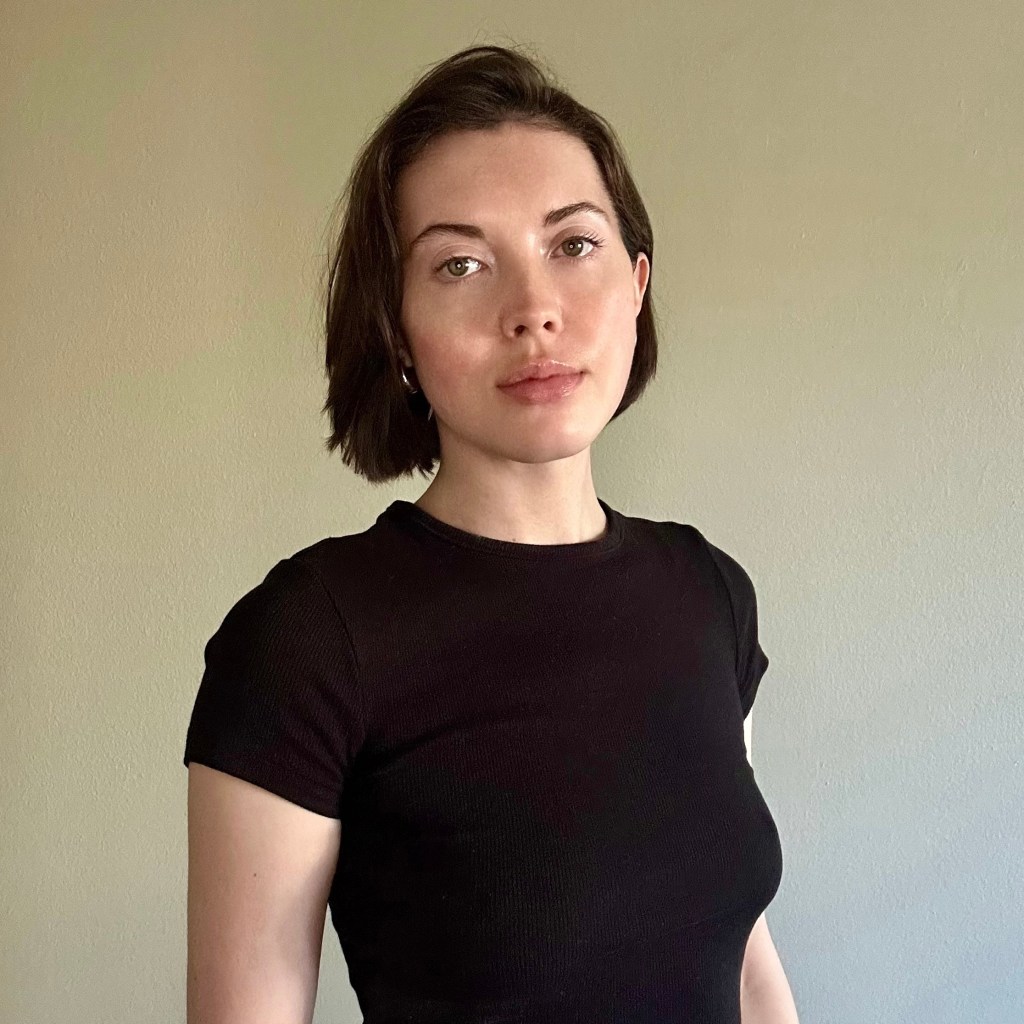
Olivia Pierce Graham: As I ponder your work, the following stanza from “The Current Isolationism” by Camille Rankine comes to mind:
A flock of birds
when touched, I scatter. I won’t approach
until the back is turned.
I’ve observed that the speaker(s) in your poems engage in a similar approaching and retreating, to and away from whatever it is the speaker ultimately decides to have the reader touch in the end. It is worth noting that this approaching and retreating does not seem to be born of indecision, but an informed ambivalence and keen intellect that considers the merit in all possibilities. I am thinking of your poem “Voyage,” which opens with the following lines:
In February error sank me
to the depths of my bedroom.
Not to surface again till June.
Vainly I managed to take care
of my face but let my body parch.
Went silent till I could call myself healed,
no longer riddled with cracks.
but eventually—and emphatically—ends up here:
The hatch opened to broad sunlight
and a trembling reunion with core self,
with my breasts and friends and cackle.
https://www.assignmentmag.com/micromag/2025/6/25/voyage-by-ellie-snyder
What tells you that your poem is finished, that the speaker has touched their ultimate objective? Are the conclusions premeditated or a discovery on your part?
Ellie Snyder: This is something that’s changing the more I write. I’ve felt like my poetry fails to pack any punch unless I sit down to write with a singular idea in mind, a story I want to tell, etc., in which case there’s a definite ending I’m working toward, however it ends up transpiring on the page. But less and less do I want things to be that neat. In American Originality: Essays on Poetry, Louise Glück writes, “I dislike poems that feel too complete, the seal too tight; I dislike being herded into certainty. And I have sought and admired (and tried to write) poems in which questions outnumber answers.” As a developing poet I don’t mind being herded, so to speak, by one I greatly admire, so am exploring how to leave room for more ambiguity and discovery in endings.
OPG: I have also noticed that, while sometimes your poems are illustrative of the speaker’s rich inner world, there are also poems that function as a detached bird’s eye view on a series of images or happenings. “Of Herd,” for example, seems to have no speaker at all. This is fascinating to me and something that I had previously thought impossible. https://thedewdrop.org/2025/07/13/ellie-snyder-of-herd/ Which kinds of poems require you to insert a human perspective, and which require it to step aside?
ES: That poem was inspired by a photo in Yellowstone (backed by my own memories of childhood visits to the park) and I liked the idea of writing the scene as though no human eye was around to see it, or maybe ever had been. I think that’s the arena to explore “speakerless” or “humanless” or “perspectiveless” poems—in whatever physical or hypothetical sphere you can imagine a world without people. Maybe one where we never existed.
OPG: In “Pouch,” there is an obvious reference to “Wild Geese” by Mary Oliver in the line, “palms pressed to the soft animal of my / belly and its coils finally[.]” This is apt as you and Mary Oliver both have a penchant for writing about animals and nature. http://thebloodpudding.com/poetry/pouch/ As a reader, what are your favorite themes to find in poetry, and who do you think addresses them best?
ES: I love nature poetry as long as it moves beyond pretty imagery and soothing metaphor. Recently I’ve been awed and unsettled by the dreamlike nature poems of Medbh McGuckian and Galway Kinnell, and the cultural reverence for the land in the work of Indigenous poets Layli Long Soldier and Joy Harjo.
I love poems about sex when done well. Sharon Olds has been my model there, making bodies and physicality graphic and beautiful in poems like “Love in Blood Time,” “A Woman In Heat Wiping Herself” and “Still Life.”
I like political poetry when done well. In my limited attempts at political poetry I’ve often thought of these words from Adrienne Rich in her essay “Power and Danger: Works of a Common Woman”: “No true political poetry can be written with propaganda as an aim, to persuade others ‘out there’ of some atrocity or injustice… As poetry, it can come only from the poet’s need to identify her relationship to atrocities and injustice, the sources of her pain, fear, and anger, the meaning of her resistance.”
I like poems that feel like a relinquishing, a sinking, a relaxing. Poems about sadness and about triumph. Poems about the unique dynamics in certain types of relationships. Poems about animals. Poems that are just little moments in a life.
OPG: Your author bios often laud fashion and fit checks. Consider the following quote from designer Karl Lagerfeld: “Like poetry, fashion does not state anything. It merely suggests.” Do you agree? In what other ways do you find the two mediums similar or dissimilar?
ES: I love this question and wrote a brief comparison of the two in Issue 28 of After Happy Hour Review: “Both the larger structure and the intricate details contribute to the look’s or poem’s overall success, though the former is taken in all at once, then can be studied more closely in its separate components while the reverse is true of the latter.”
My personal style is the other way in which I feel most creative—if anything, I’m far more confident and prolific in my creativity there. And I like Lagerfeld’s simile. I think it ties in with Glück’s words above in that to some, a more interesting poem might be one that leaves more up to the imagination than it states, just like a well-turned look follows the Rule of One. That said, I’m a fan of an outfit that leaves nothing up to the imagination sometimes, and I’m a fan of a poem that says exactly what it means sometimes.
OPG: Your poem “Macallan” is one of the best poems I’ve read in the last year. I think of it often; the way it exists in a liminal space; the way the last line doesn’t feel like a conclusion, but like the poem was interrupted by the speaker’s waking. This poem reminds me of the kind of dreams that we are disappointed to wake from because we wanted to stick around and learn the ending. There is a feeling that the poem isn’t gone, but that it’s still carrying on somewhere—it could be finished if only the reader knew how to find their way back to it. https://deathrattle.org/vol-10-1/snyder Could you talk a bit about a favorite poem of yours that immerses the reader in its atmosphere?
ES: I’d love to take the opportunity to highlight my recent poem:
Joanna
To reach her from the south you climb up from between copper mountains.
But east is the long plain of the lake strewn with copper antelope.
The people have chosen to drive an hour into Helena for decent produce
or half that into Townsend for a beer and a little company at Commercial.
The land is drunk with ghosts and what water comes darkly over the north hill
in the switching seasons. With her the fish play games when she scales
rivers for them, bear huffs through the window of the facing bank.
To her the snow is a quicksilver friend. In her the span has begun
its theft. Weeds encroach on the less-traveled game trails of her thoughts,
she is easier tired by wind and misses her ears two sharp blades.
Between the road, the lake and the little towns are many years but
she came here new, no generations dug in or tradition to take up
like coursework. When she goes she will go from the plain and the world.
When she came the earth hitched to accommodate this new distribution.
I was reading a lot of Louise Erdrich, through almost all of whose books runs a current of ancestral intimacy with the land. I was thinking about how I identify as a Montanan because I grew up there, but my family holds no real longstanding ties to the area. So I wrote a poem in which the landscape described is very real (and I hope atmospheric) but Joanna is a fictional representation of an implant—she came to this area which has a ton of history but none involving her or her people, and when she goes, or dies, it won’t leave a mark in any tradition. The last line is an attempt to convey that even these tiny comings and goings are important.