Sublunary
- Home
- Sublunary
Whether evoking Emily Dickinson’s singing to nature, or one’s families’ habits, there’s a reliance on the natural world, that’s immediate, irrefutable: “I awake as a winter squash, others an antique / sewing machine.”
Austin Poetry Review
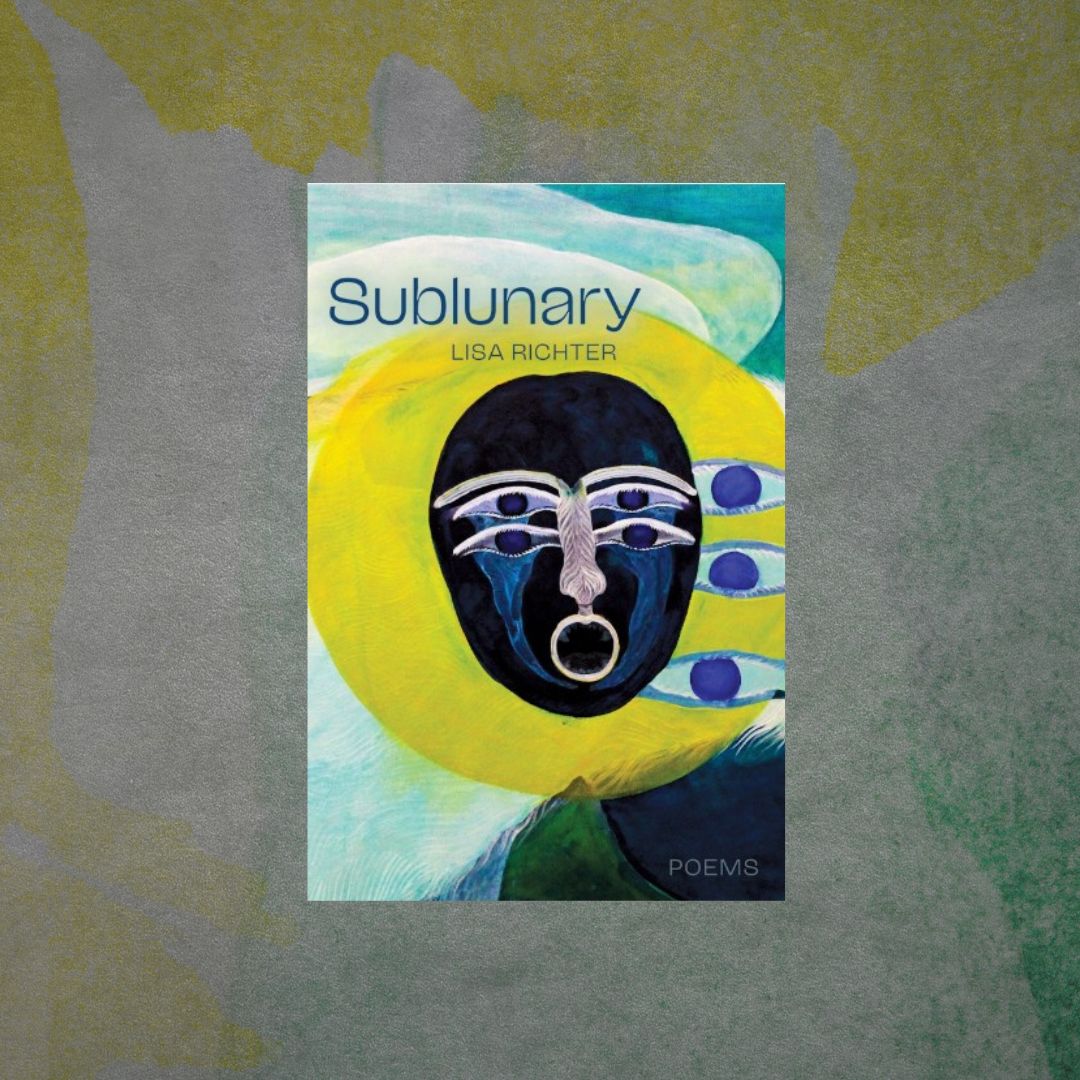
Sublunary, by Lisa Richter
In the opening poem ‘Staying Power,’ one interpretation of the repeat of “I stayed” with the last stanza “I stayed silent” could be seen as a reproach on the human tendency to endure without protest. In the context of the powerful cover by Runa Ikeda called ‘The shadow of the living light’ (生ける光の影) there is a perpetual umbilical to the natural and ancestral world of all indigenous peoples and fauna, in contrast to the flippancy of the modern world:
I stayed with and occasionally out of trouble I stayed
wired until daylight texted its imminent return
I stayed silent and looked away when the wind
stripped the dying leaves of the only home they’d ever known
In these lines, the divide between modernity (texting, plastics etc.) versus staying silent as nature is ravaged, speaks to the environmental catastrophe around us, without overtly calling it, using instead, irony in titles like ‘Minor Worries’ with the lines: “May the minks in their cages / swim free among the minnows.” Poetry has a method of harnessing a message without literals, and that can be a more powerful attachment ‘Staying Power’ is also a key practice in the Jewish mystical tradition known as devekut (Hebrew: ‘clinging/cleaving’) characterized by a, “strong connection to the physical body and physical world,” marking this writer’s intention with ‘Sublunary’ to accomplish just that.
The sea
Would sing back to me in a deep bluesy alto,
Desperate to please, or leave what you’d call
Its mark. We all suffering from this affliction
In my family. If we couldn’t be preternaturally
Likeable, we’d be different, we’d be aggressively
Magnetic. (Hermit Aria)
Whether evoking Emily Dickinson’s singing to nature, or one’s families’ habits, there’s a reliance on the natural world, that’s immediate, irrefutable: “I awake as a winter squash, others an antique / sewing machine.” (New Year’s Day Lament) binding human feelings (of losing her father) to nature’s exhaustion:
Dear Dad, I am writing you from the bottom
Of the ocean where my eyelids
Are bottle caps and my stomach turns
Burnished copper.
This mélange of wisdoms and cautions, is blended into a thick bread of knowledge, building on modern totems like artist Yayoi Kusama’s Infinity Mirrored Room and the surprising beauty of images pressed into language:
And if you haven’t learned the fifty names
For darkness. The Godhead is a tulip flashing you its tongue.
Your alliance with the universe comes
With an expiration date. No one gets repeated
Without first repeating the past. (Today the Universe Can Be Viewed by Members Only)
In ‘False Awakening,’ Richter employs powerful imagery to speak of human’s inclination to waste time creating order against nature, the futility of thinking we’re in control, the stuffing down of what actually matters, hence the play on words title:
A corridor opened in my chest from which five
cedar waxwings flew out. How many years of my life
have I wasted trying to find matching lids
Richter’s deliberately jarring juxtaposition of modern terminology, against a flicking natural world, contrasts the two, showing the insubstantiality of modernity versus the deeper nostalgia of lines like: “Perhaps deep in the equatorial rainforest / there is a plant whose blue-green leaves can heal the wounds that / grief inflicts, or prevent the deaths that exact our grief.” (Frog Rain) Less driven by intention, more the unspooling of a non-human understanding, in revolt against the superficiality of interior lives: “Humanity is pretty cringe but also foolishly loveable, / like a stick bug gorging on currants.”
This wax and wane between human perspective and something far greater, is smartly driven throughout this collection. Often creating a dialogue of sorts, both educative, humorous and tragic with lines like: “Can you unravel the secrets of the cosmos / and find your way back to Earth before time runs out?” The double meaning, superficially funny, but hinting at a portending truism, is deftly juggled. Above any other consideration, Richter returns to her role as canary in the coal mine:
The planet looms below me,
the giant eye of a patient octopus.
I’m so flooded with love
I can barely keep from sinking. (Between Falling to Earth and Floating in Space)
In ‘Crashing the Floodgates’ we can unpack several co-existing themes; floodgates hinting at a dissolving ecosystem, ‘before times’ furthering that theme, but juxtaposing ‘Victorian’ to hint of a past that led to this downfall, where the “insignia / of our misgivings” lead to ignoring signs and eventual doom:
Three blocks away, we found our innocence
Hunkering with our cat in a dollhouse. We thought
Our megalomania would be under the doormat
Where we’d left it, but instead uncovered a medieval amulet,
The omnipresent humor acts as rodeo clown, distracting, amusing, but only a respite before again, we are led to consider the ruin around us, a projection of a future everyone’s busy denying is inevitable. Using artifacts as props and clues throughout. There is a sense of loss here, but also warning, maybe it’s not too late? Richter treats her poetic character as sign posts to speak of emotions:
I would like to speak to the manager
To file a complaint about this timeline.
Which trickster has removed the reset
Button, preventing us from attempting
A second take? (Tabula Rasa)
In using cinematic and highly visual props, the true message comes through without being deluged with grief. We can all relate to wanting a ‘do-over’ and this applies both to those we’ve lost and the world we’re slowly destroying. She asks in ‘Flotsam and Jetsam’ the eternal question; “What is the true cost of remembrance?” The idea memories torment as much as soothe, and loss cannot be shellacked over and forgotten, it inherits itself, as the world loses more of its solidity with every human error. Richter talks of ‘shadow puppets’ and scouring distractions to; “stave off loss, the fallacy of ownership, / our penchant for drama, such charming tragic flaws!” Even the poem’s title: ‘The Thrill of the Find,’ is a double-meaning, where loss and outcome are undeniable, both personally and universally:
The equal ratio of daylight
Hours to night won’t release the plastic bags
Clogging beluga stomachs, won’t bring you back
From whatever game show in the afterlife
Has made you its host (Equinox in the Crystal Forest)
Repeatedly Richter aligns nature against human-foible, explaining through poetry, why we’re in this mess. Her voice becomes universal in its question:
Are you listening, old poet? Say the world
And I will scrap the artichoke sky with my teeth.
Say the word and I will plant you an acre of crystal forest.
On the surface this appears surrealist, an imagining, but beneath, we’re talking of a woman’s hopes of saving the planet, her passionate entreaty for us to pay attention. Part languid regret, part battle cry, it’s never far from any poem in this collection:
If only we’d known the posts and beams
Above us were part of a whale’s ribcage,
That the throbbing bass we plugged our ears
With clay to muffle was its moon-sized heart. (A Portrait Made of Seaweed)
The ache with which Richter laments our foolishness as a species, and the consequences of that oblivion, is interspersed with memories, both intensely Jewish and other, lining the life of a woman incapable of closing her eyes to the ruination of the natural world around us. Unexpectedly, despite this being intelligently activist, Sublunary is as beautiful as it is educative. Perhaps as the author says at the end, where taking the course “Miracles and The Strange,” deepened her relationship to the long Jewish tradition of fabulism and storytelling and beyond all of this, there is the simplicity of love, perhaps our redemption, or opportunity to reverse before it is too late, best evoked in the last poem, the eponymous and bewitchingly lovely ‘Sublunary’:
I tried to impersonate the kind of daughter
you wanted, the kind who travels the Siberian tundra
to pick a single magic flower from a haunted forest
as proof of her love and allegiance. As it happens, I am
the flower, and the forest, and the tundra.
Candice Louisa Daquin, Managing Editor, Lit Fox Books. Consultant Editor, Queer Ink and Raw Earth Ink. Poetry Editor, Writers Resist, Tint Journal. Author, The Cruelty (FlowerSong Press, Fall 2025).