Absurd Theatre
- Home
- Absurd Theatre
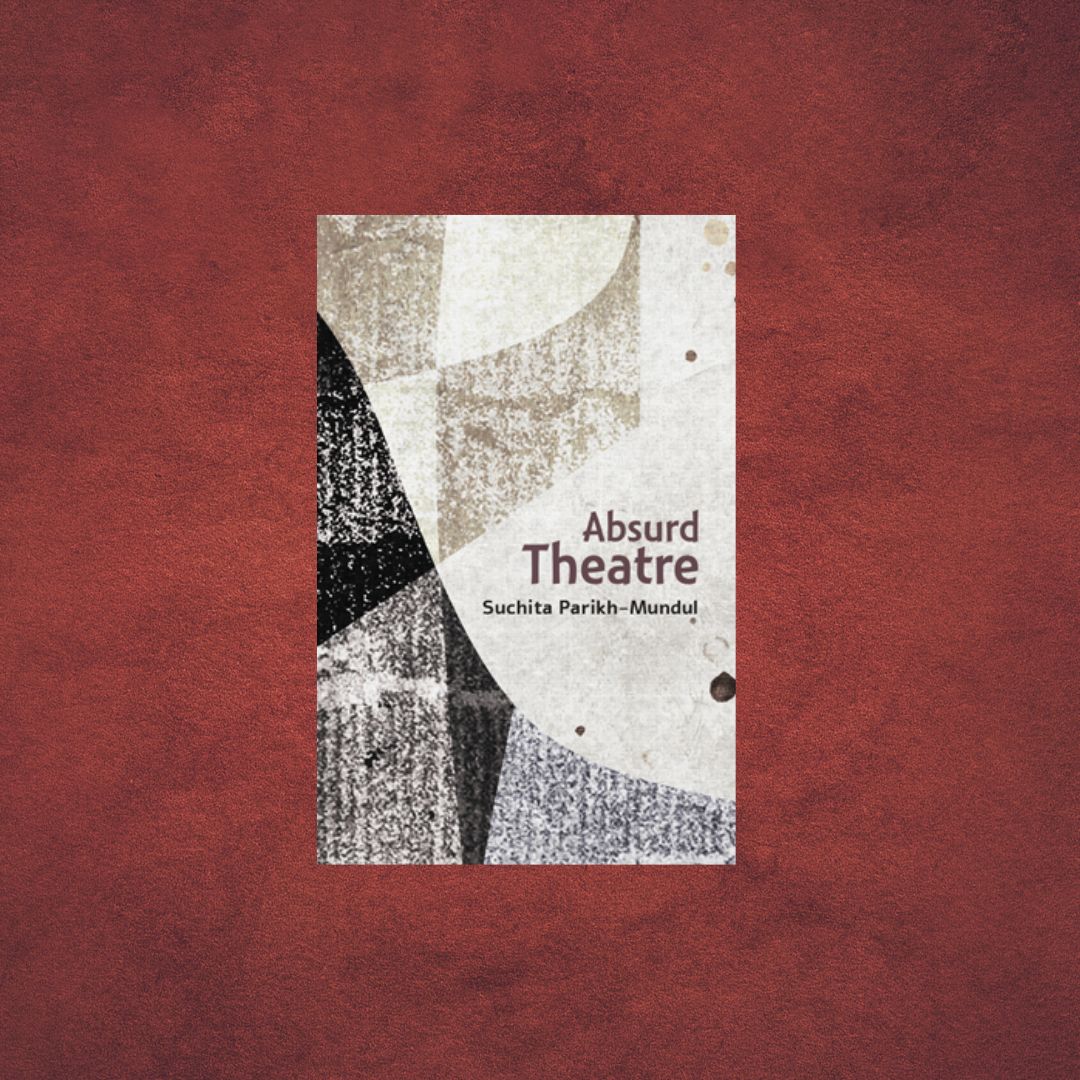
This prescient collection by Suchita Parikh-Mundul, uses the Latin literalism of absurd; ‘discordant’ and theater; ‘to behold’ very cleverly, to speak of the embedded layers of social distortion and poetry’s ability to convey truths within itself.
Austin Poetry Review
Absurd Theatre by Suchita Parikh-Mundul
Absurd Theater is dedicated to all those who have been lost, where words are actors, engaging with ordinary everyday occurrences, revealing an unexpected profundity and enduring significance. Where cues are complex and simple both; contemplation resisting analysis and meditative states reject our mechanistic wont. This prescient collection by Suchita Parikh-Mundul, uses the Latin literalism of absurd; ‘discordant’ and theater; ‘to behold’ very cleverly, to speak of the embedded layers of social distortion i and poetry’s ability to convey truths within itself, set against humanity’s odd shift between wanting truth and meaning, yet continuing to obscure it:
Here the air is humid
with godsong and bursting
with the fire of stars. Everything tastes
of prayer even if you don’t believe. (Godsong)
Whether in South Asia or another land, the meandering landscape of city and still countryside within this writing, its fervor in connecting visual writing to actual places, ties the physical and psychological inextricably, weaving a tight knot; “Here, where sacrality is in breath and stone,” The reader takes this journey, to contemplate alongside the poet, within the ‘limbic system’ of the poems, what conclusions about poetry and the wider subject of selfhood, can be wrought:
The silent gathering moves
like a murmuration: white kaftans travelling down
the narrow lane, a poetic flutter against cement. (Roots)
The apparent simplicity of paralleling one’s origins with the vehicle of poetry that is living and breathing, becomes texturized by layers of adorning cityscape and natural world languaging that is “slow and mesmeric,” a codeswitching pilgrimage, one might say, to the center of this poets cultivation of herself within the greater world. Arguably this is a memoir in poetry, without being completely about oneself, as it continues to ever expand to encompass Parikh-Mundul’s luminescent surroundings and conclusions:
On a solitary evening, the sun, with its last
breath, speaks in a muffled rush. You hear
its soul burning but the nuances are unclear.
Its fading light, as recognisable
as a dying marriage, (Lonesome)
In her poem ‘Discontinued,’ Parikh-Mundul writes: “Let words / trapped between lines / find me” when paring the allusion within the title, it could be pointing to the need a poet has to express themselves, the struggle to do so, forming a poetic state of tension, where the only resolution is found in harmonizing ones need to speak with ones deepest self, and with that, there comes release:
Sigh deeply
to release what is trapped, and leave
the scene so the poet can develop further. (Museum of Sighs)
This is a familiar transformative process, whereby one’s identity is forged in what is chosen to contemplate and then write about, where it is less about conscious purposing, than a resulting learning through experiencing and just how we choose to experience:
When it’s time to leave,
its ribboned length
fastens to your ear
and continues the tune
in silence. (Choir)
Perhaps we are talking about a form of worship, or religious fervor within the elasticity of writing and poetry, a depth located when one is immersed in poetic-form and rhythm. Like Woolf and Sexton, Tagore, Kamala Das and Mirza Ghalib, an encounter with the deep exploration of the boundless and eternal strings of poetry, that are indistinguishable from our own blood, with hypnotic lines like: “After meals, I / drink water that tastes like temples” (Although doctors recommend not to). The poet’s considerations like in the apropos titled ‘Waterbody’ are inflected with evocative, lush imagery: “I am now of that age when I sit awhile / watching water continents form on bathroom / tiles, repeating the life I have lived.” Often what is literally said, versus physically felt, in reading and writing poetry, can, if we are tuning in, take us deeper into the veins of poetry and its enabling force urging us to clarity or reconciliation:
Imagine — as tired blades of the fan mimic
tropical birds and bother still air —
the silent disturbance of winter
and the eventuality of last breaths. (Against heat)
Poems like ‘Elegy to an unkind aunt,’ which is ‘After’ the baffling quasi-surrealist film ‘Everything Everywhere All at Once,’ demonstrates an alacrity of conceptualization in respect of reality and how the obscure, can elucidate hidden emotions, revealing in their seeming disparity, a truth we didn’t know we needed, alongside the rather quixotic temperament of creativity and output. Here we find, an initial glimpse doesn’t always show the entirety, and much of our conclusions are based upon the emotions we take into the experience; where we really are; “remnants of a galactic implosion, mere cherry seeds.” (Garden time). But unlike a pure surrealist, this poet’s vision understands, there is also power in making sense of the nonsensical:
Her cruelty blended with
the realisation that she was
the opposite of love and
a twisted form of it, a reality
I accepted like the film I disliked
until I loved it.
Even in poems that do not promise depth, like ‘Mamography,’ we find the poet capable of locating a divining rod that meshes our inner and outer lives far beyond the sterility surrounding us, remaining true to the poets natural harmony outside prescription, and echolocating into abundant language forests:
After their topography
is studied, gloved hands
return me to myself, and like
liquid, I form the shape
of my vessel again.
The final poem might further elucidate the poet’s ultimate destination, metaphorically, acting as prognosticator through the words:
this vault that stores
decomposed remains, but never
the burning flesh. (Addiction)
Whilst poetry is always open to interpretation, my take on it, is the idea that we, as vessels, carry our memories, lives and landscapes within us and even in death, those energies do not stop burning passionately. What appeals most, is the idea we can tune-in to the incredible, to the gorgeous spoil of poetry, using the illumination of language to affect this longed-for transportation, and once therein, stay in an Absurd Theater, where actors become totems, become signposts, become hope; and our arrangement of what ‘makes sense’ seems somehow irrelevant:
The fur of sleep
wound around tree and road
unwraps without hesitation or complaint. (Another day)
Candice Louisa Daquin, Managing Editor, Lit Fox Books. Consultant Editor, Queer Ink and Raw Earth Ink. Poetry Editor, Writers Resist, Tint Journal. Author, The Cruelty (FlowerSong Press, Fall 2025).