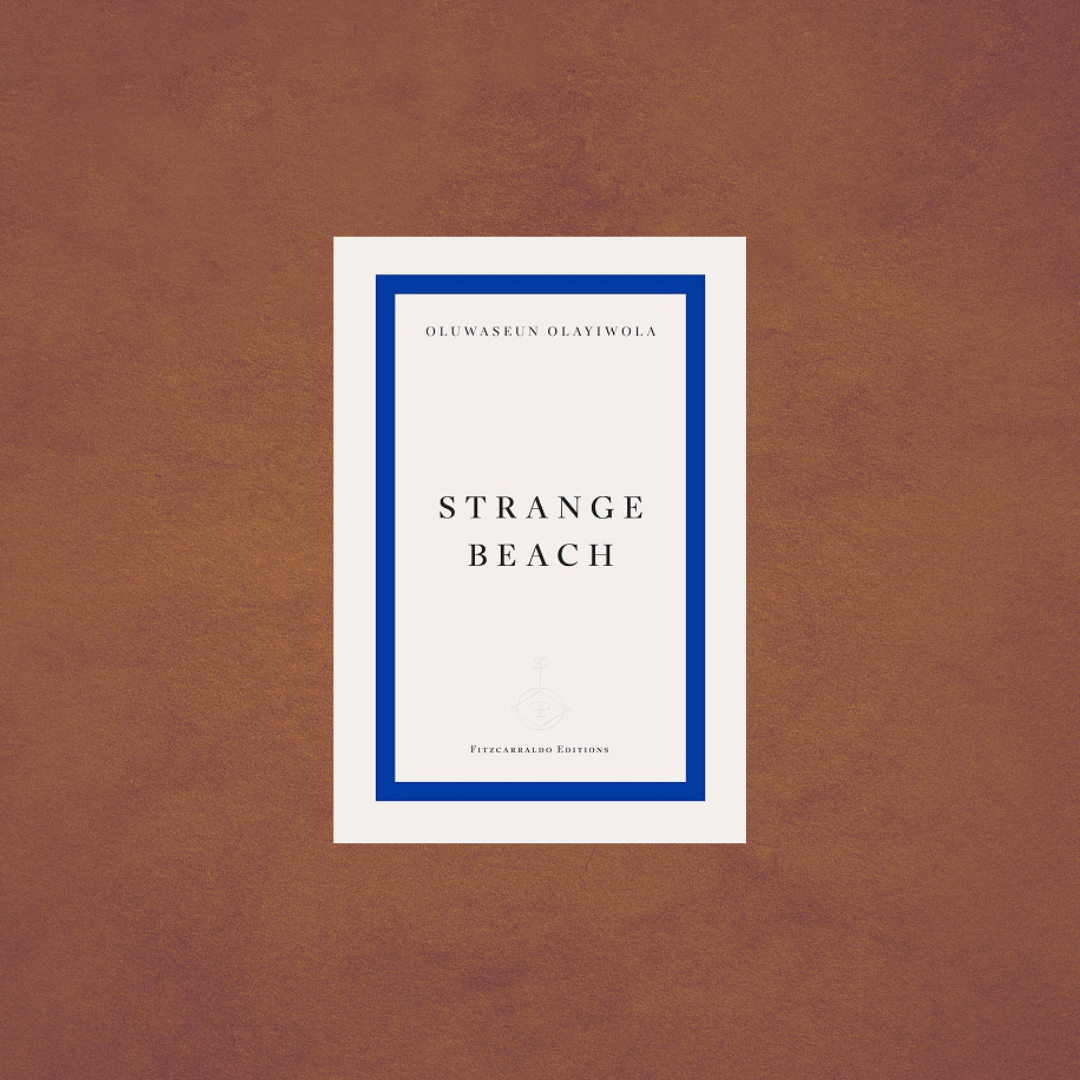
Strange Beach
- Home
- Strange Beach
...a poly-sensory journey into the depths of black queer masculinity, familial estrangement, and self- and sexual reckonings.
Nicole Yurcaba
Dissecting the Hollow Carcass: A Review of Oluwaseun Olayiwola’s Strange Beach
As seamless and endless as the ocean itself, the poems in Oluwaseun Olayiwola’s Strange Beach provide a polysensory journey into the depths of black queer masculinity, familial estrangement, and self- and sexual reckonings. The poems in this collection ebb and flow and crash into readers’ consciousnesses, luring readers into the sharp and languid blue existing in every line. Fluid yet gripping, Olayiwola’s poems are formidable and eloquent, passionate and introspective.
In poems like “Animal Song,” Olayiwola employs a Romantic insight that reveres the natural world. However, the image of “a scarecrow in the field” evokes the idea of humanity’s influence and incursion on nature. A “stampede of pigs” surrounds the scarecrow, but the poem’s focus is solely on the scarecrow. The speaker notices where the scarecrow has been “sewn up, as in repaired,” as well as the “stacked lesions” on the scarecrow’s back. The speaker seems to empathize with the scarecrow, acknowledging that it “takes a dark / to know a dark.” Four lines center the poem:
There are those we let have sway over us.
There are those who innately have it—There. Go.
With your feet. Into the designated pen. I can follow
and be quiet. Weakening, then truly weakened.
A sense of submission emerges, and the repetition of the phrase “There are those” reinforces the concept of emotional weakening that develops as the stanza concludes. The punctuation of the line “There are those we let have sway over us” combines with the punctuation of the words “There” and “Go” to bolster the speaker’s submission. This punctuation technique continues in the fourth and final stanza. This stanza relies on rhetorical questions like “When does it become / trespass?”—a question examining the fine line between willful consent and reluctant, even forced, submission. An em dash punctuates the poem’s final line: “we had thought it departed—.” This technique loosens the line, forms the idea that the speaker’s situation—as well as the scarecrow’s—is never truly resolved. The em dash also implies that the speaker is, regardless, moving on from the situation and potentially into a new emotional state into which others cannot enter.
“Beacon” echoes the emotional isolation of “Animal Song.” A slim poem consisting of 14 clipped lines, it is a prime example of Olayiwola’s gift for compacting existential, seemingly inescapable, drama into few words and few lines. “In the end, the lighthouse / we had walked to / was never the point, being” states the speaker. Again, a sense of submission materializes, as does the awareness of one’s finite existence and an admission of nothingness: “only what we were / to the sea: blank moons / inside us, waxed.” These lines seize the collection’s overall universal theme: in the correlation to nature, humanity is powerless despite its belief that it can conquer anything. Nonetheless, the idea of individual erasure—not only by nature, but also by other individuals, including that one trusts and loves—dominates. The simile “like exposed oysters / down our throats” acts as the poem’s transition point, one revealing the speaker’s struggle. The poem’s final two lines—“We climbed a ladder to the top / because there were no stairs”—is a gorgeous conclusion, fully capturing the emotional tug-of-war not only between the speaker and their partner, but also between humanity and nature and humanity and time’s ravages on a relationship.
Olayiwola’s poetry not only navigates the plateaus and tumults of romantic, familial, and erotic relationships. A few of Olayiwola’s poems consider the intimate, and frequently frustrating relationship, between poetry and the poet. Poem intimately considers the way a poem works its way into the speaker’s mind, life, and daily existence. The poem appears an uninvited entity, one that arrives with “asphalt weights” around its “wrists.” The speaker’s personification of the poem, at times, seems malicious:
You took risks, you defined mercy
as survival, keeping the tested traditions
of your mother alive.
In reality she is not dead
but writing is, at its best, protest.
Not protection.
Despite the malicious cycle writing poetry inflicts on the speaker, the speaker also acknowledges that writing poetry is inherently necessary for them. The poem surfaces as an unextinguishable, limitless entity:
You want to see to the end of the world,
you want a heartbeat of smoke
to pursue you like a voice
charmed out
by the universe’s brass instrument.
The speaker’s recognition of the poem’s desire to “see the end of the world” facilitates a dystopian tone, a tone that deepens the personification as the poem moves towards its conclusion:
It is not just your soul floundering
for permanence. The leaves are old crowns
rejecting the cobblestone
they are framed inside.
The statement “The leaves are old crowns” displays a futility mirroring that in “Beacon.” Once again, the natural world becomes a prominent force offering rejuvenation, recovery, and a place for fulfillment. Two rhetorical questions—“What will you do when they clear out?” and “What will you do when they are all but cleared out?”—act as the speaker employing the poem to explain its actions and to also take responsibility for those actions.
Olayiwola, in poems such as “Orchard” and “Now,” claims their place among the Black Romantic greats like W. E. B. DuBois. Simultaneously, Olayiwola, stylistically, resonates with Yusef Komunyakaa. “Orchard” is rife with longing, rejection, and pleas for acceptance. It linguistic simplicity enables its musicality and frames the speaker’s environmental and situational insularity:
Leave me alone, nature,
alone, obedience. Terror
buried in the ink-white map. No sky-clot,
no light finally, birds.
As the poem continues, its form breaks, yet remains simple:
Gravity thirsts—because I feel it. Leaf-crush.
Boots mute.
I inhabit his orchard, am ingrained. Like a perennial.
The brief and quickly punctuated lines generate a snap, a closure, and a reinforcement of the speaker’s inability to escape their insularity that seems to stem from their relationship with the unidentified “his.”
“Now,” too, relies on linguistic simplicity to facilitate its emotional grasp. Once again, Olayiwola’s gift for seizing insular moments and existence and rendering them into words glistens. The sleek eight-lined poem’s compactness elevates the simplistic language. Nature’s forces provide a stable background: “Hiss of the wind, stirring above us / in a music, drowned mouths—.” The poem’s erotic undertones are fortified by the minimal structure and language. The speaker shares how their partner “slides his hand” into the speaker’s “city,” an action the partner reciprocates until their hand “is disappeared.” The phrase “is disappeared” concludes the poem in a magical, ethereal way, creating the perception of a strange, existential duality. At first, the phrase can be interpreted as an admission of nothingness, while a second reading can be interpreted as an acknowledgement of oneness and/or togetherness.
Of course, Olayiwola’s Strange Beach, in its entirety, is a poetic documentation of the strange, existential duality few dare to admit let themselves enter let alone write about. Olayiwola’s poems tug at existence’s fringes, pull the fringes together, and tie them using words and images that celebrate nature, eroticism, and emotional planes on which the speaker establishes as their own. Strange Beach is also a careful, brave dissection of truth and the liminal spaces in which an individual strives to find it—no matter how uncomfortable and jarring those spaces prove to be.
◊
Nicole Yurcaba (Нікола Юрцаба) is a Ukrainian American of Hutsul/Lemko origin. Her poems and reviews have appeared in Appalachian Heritage, Atlanta Review, Poetry Ireland Review, The Belfast Review, Abridged, Seneca Review, New Eastern Europe, Euromaidan Press, Chytomo, and The New Voice of Ukraine. Nicole holds an MFA in Writing from Lindenwood University, teaches poetry workshops for Southern New Hampshire University, and is the Humanities Coordinator at Blue Ridge Community and Technical College. She also serves as a guest book reviewer for New Eastern Europe, Tupelo Quarterly, Colorado Review, and Southern Review of Books. Her poetry collection, The Pale Goth (2023), is available from Alien Buddha Press and her chapbook Have Your Eyes is available from Dancing Girl Press (2025). Her poetry chapbook Hutsulka (2026) is available from River Paw Press. She divides her time between the United States and Ireland.
Candice Louisa Daquin, Managing Editor, Lit Fox Books. Consultant Editor, Queer Ink and Raw Earth Ink. Poetry Editor, Writers Resist, Tint Journal. Author, The Cruelty (FlowerSong Press, Fall 2025).