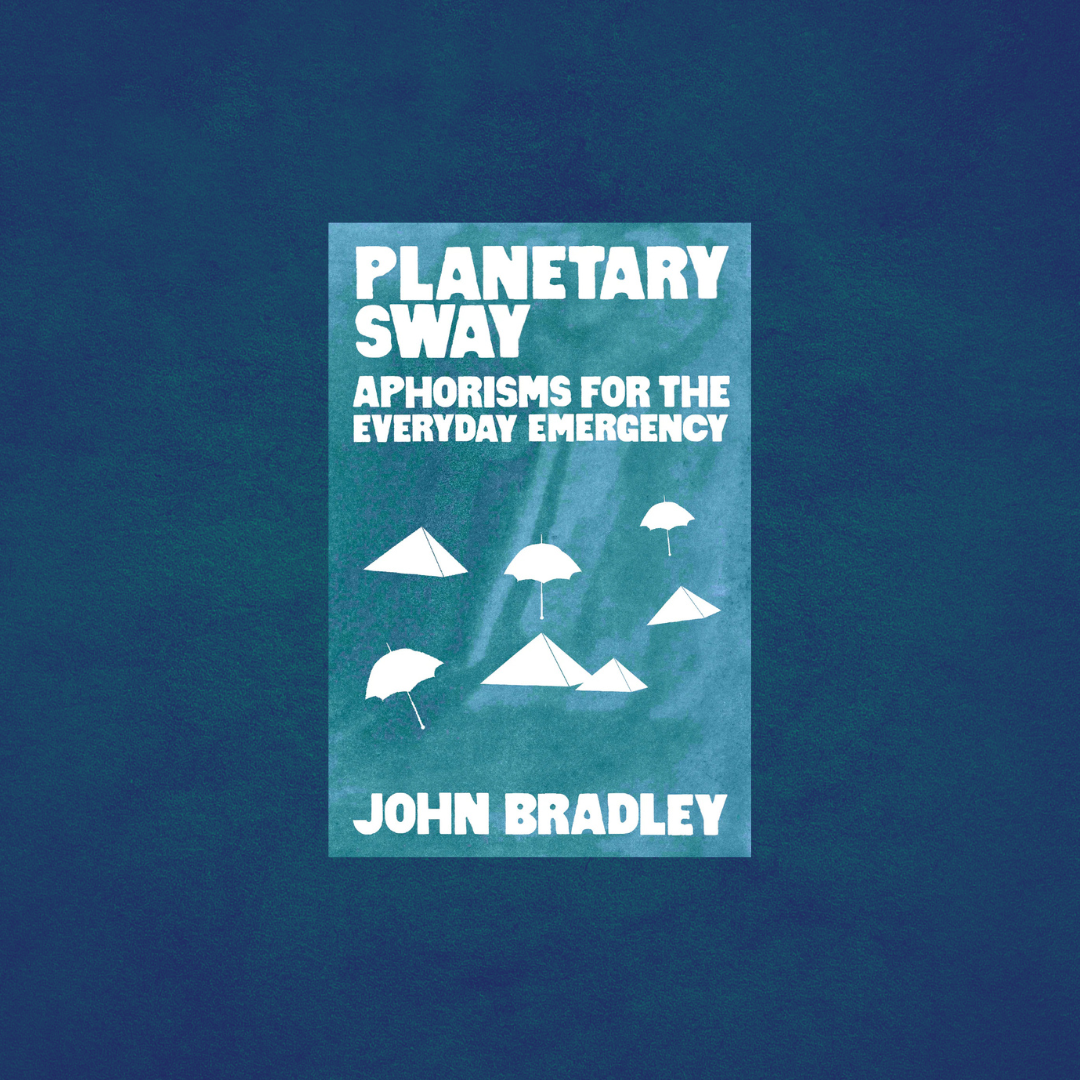
Planetary Sway, Aphorisms for the Everyday Emergency
- Home
- Planetary Sway, Aphorisms for the Everyday Emergency
Bradley asks his readers to suspend their disbelief, and, in imagining, to expect the unexpected. “The glass eye in the glass of milk can see, I’ve been told, the flies that have settled on the moon, and the bits of moon dust that settle on the back of each ant."
Peter Mladinic
Planetary Sway, Aphorisms for the Everyday Emergency
The poet James Dickey said lines are little poems. The same may be said of John Bradley’s aphorisms in Planetary Sway. Adhering to the adage less means more, Bradley gets right to the point in “little poems” that sooth and stimulate the mind and the senses. He turns the illogical into the logical in these investigations in the possible. Intuitive and imaginative, the poet shines his figurative flashlight on dark corners; he illuminates. Three things that make John Bradley’s aphorisms his reader’s are a tone of intimacy, an abiding imagination, and a delight in construction.
Bradley’s tone of intimacy involves risk, affection, and affirmation. He addresses not the crowd but the individual, as if saying “this is from me to you.” He glides from the impersonal to the personal. “Once you’ve uploaded my voice into your speech program, I can assure you that we’ll become the best of friends” (1). A shift in mode complements the tonal shift in “I’ve made a copy of you out of fallen leaves, my love, should you ever tumble-flutter-fly apart” (6). This wedding of the cohesive and the fragmented involves risk. Seriousness belies playfulness, or, rather, the two are intertwined. On a light note there is this bit of sharing. “True, he made the loaf of bread using cement. But you must admit, it tastes a lot like the last century” (11). There is love in the air in “You were in your anti-gravity gown and I in my levitation suit. How could we not have embraced?” (12). The poet, alive to the world around him, speaks to the individual.
As with Coleridge, Bradley asks his readers to suspend their disbelief, and,
in imagining, to expect the unexpected. “The glass eye in the glass of milk can see, I’ve been told, the flies that have settled on the moon, and the bits of moon dust that settle on the back of each ant” (8). With vision that good, the eye needs no contact lens. The poet observes and tells what he’s seen. “A museum from Argentina rode by on a bicycle while you posed on an empty plinth” (13). That is followed by this showing and telling. “The door in his forehead was so small only an enormous lie could enter” (16). And then, “I sing, explained Lorca, so the security guard will bow down and kiss the vast asphalt. I sing so a grilled cheese sandwich bearing my image will not consume the water tower” (23). You can’t make this stuff up? The poet does, and in doing so he makes his world his reader’s. A world in which imagination is alive and well, and a glass eye sees a fly land on the moon.
Note parenthetical elements and modifiers in the aphorisms, and consider how lesser the last example would be if “bearing my image” were not in it. Every word, every syllable is an integral part of a whole. Just as Bradley’s exercise of his imagination is vigorous, or rigorous, his delight in making linguistic constructs is obvious. Here is a poet having fun, playful and dead serious in working with phrases and clauses. Note his work with water and repetition. “The faux jaguar will only drink faux water on a faux day, unless you happen to bring it a cup of freshly washed unearthed quartz pebbles” (7). The following aphorism takes its cue from the Garcia Marquez story “A Very Old Man with Enormous Wings.” “After I inflated the car and watched it float over the meadow, I heard a hissing in my left foot” (1). He delights in metaphor, as things turn into other things. “Your translucence lingers outside the door that was once a windmill that was once a coffeemaker that was once a mirror rooted in a cloudy cornfield” (7).
Nearly a half century has passed since John Bradley stood before an audience in Minneapolis and read a poem about rats that has surrealist elements similar to those in Planetary Sway. This reviewer was in the audience. I knew the poet only very casually, but I felt as if he was speaking to me personally. The same holds true today. These “little poems” that say a lot come out of the poet’s experience of being alive to the world around him, attentive to “the everyday emergency” he must navigate to survive and thrive. That he turns his experience into illuminating aphorisms is his readers’ good fortune. Planetary Sway is smart, and rich in emotional import. An original in the best sense of the word.
–Peter Mladinic
Candice Louisa Daquin, Managing Editor, Lit Fox Books. Consultant Editor, Queer Ink and Raw Earth Ink. Poetry Editor, Writers Resist, Tint Journal. Author, The Cruelty (FlowerSong Press, Fall 2025).