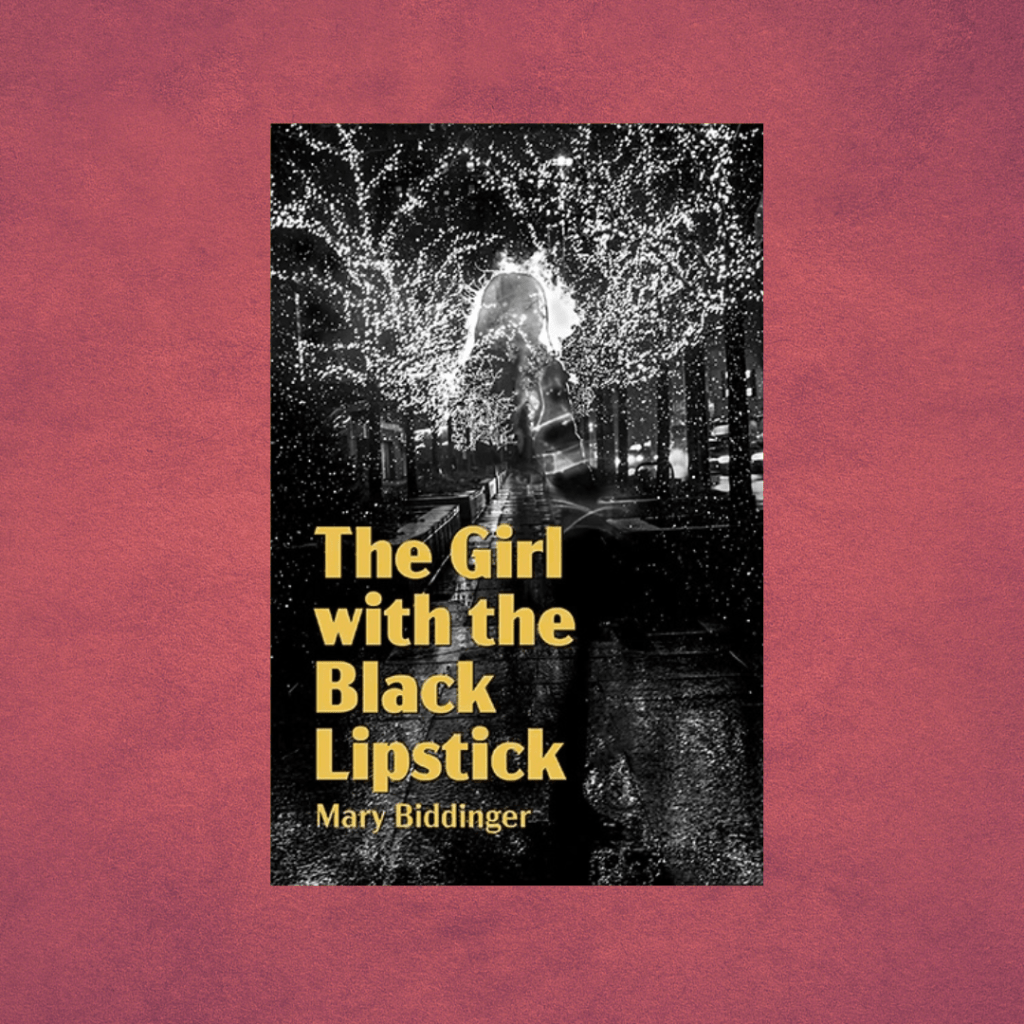
The Girl with the Black Lipstick
- Home
- The Girl with the Black Lipstick
Mary Biddinger doesn’t care a damn whether you denounce her post-modern experiences.
Austin Poetry Review
The friend who sat opposite you swigging from Mad Dog 20/20 telling the best stories? Stories you appropriated and pretended were your own? The Girl with the Black Lipstick is a collection of those ‘remember when?’ archetypal moments in time. Mary Biddinger doesn’t care a damn whether you denounce her post-modern experiences. Her Trainspotting infused experimental prose is freed of self-consciousness, which is why it gets its black nails underneath you and engages you into feeling something.
It’s raw, sordid and blessedly unconventional, in the pre-digital maze of comparison, Biddinger distinguishes her style by diving face-first into sardonic introspection and pulling you along for the thrill into that full lipped era of piss-n-vinegar and unclean nails. You can almost smell the magazine paper, “I recalled how Seventeen magazine convinced me I would turn / heads in blue mascara.” Alongside the soft despair and impatient sexuality, Biddinger delivers lines like a ring-master:
I could still walk in stilettos, but only wore
them to academic conferences, for the slut-scare factor.
For those of us alive circa 1998 and old enough to rebel, this series of miniature memoirs will grip you by the throat in their lurid recollection of a time where we could get away with things, as evidenced in classic titles like: Photos We Never Took in 1998. Don’t mistake this style for ignorance or frantic self-exploration at the reader’s expense. Biddinger is a tutored writer alongside rebel, her wordplay is cinematic, aggressive, tightly-woven and requires careful reading, to avoid missing the multitude of aesthetic references:
My roommate smoked indoors and crushed out every cigarette like
a French nanny. More often than not, I was deep in a primitive version
of fin-de-siècle cosplay.
The book could come off as pretentious, if it weren’t so obviously real. This collection of stories, rolling in the mouth like a gob-stopper changing flavors; eliciting memories of an era not profusely written about; an era Gen Xer’s hold much reverence for, in its squalid, pre-internet utilitarianism and broken-apart brief encounters:
Pranking my ex-boyfriend
from a heavily tagged payphone.
Biddinger evokes a wry, diverting squalor that time has lost, with our clean 21st century faces, we possess little acute memory of how post 1980’s there was still legit disaffection brewing in the bellies of the young, a hot-tempered urging to identify and revolt and at the same time swallow the grotesque illusion that anything was worth bothering over. Think about how much is now consigned to recent-history? VHS, music-tapes, Blockbuster, tobacco pouches, print-comics, the dirty realism of a world void of social media and its touch-up-brush, is fastidiously recalled:
I opened
a solitary bar of Dial like it was a freak condom. Peered across the
alley at my apartment building, as if I was leaving one body at home
while the other hovered in two inches of hot water.
Why are those memories so lovingly evoked, if in part they are pins? Because it’s proof of life, in a visceral way few things ever are, behind our safe screens and filtered expressions. The 90s were not camera ready, you couldn’t reference things, poverty was a verb, anger a first date: Biddinger, having judged others writings extensively, has the lit-insight to pare her own memories down to those nuggets we intensely relate to, or at least ‘get’ on some primal level:
There’s a point in every degree program when some people become
speakers and the rest either listeners or furniture. I overthought my
style to the extent that I dreamt about crawling across a room-sized
eyeshadow palette.
It’s a form of pastiche or dark-humor to portray without further explanation in a quasi-surrealist, loose-limbed fashion, the clutter of one’s youth, with all its seedy sexual exploits, angsts and secret longings. Many have tried, not going far enough, resorting to cliché, or standing on the edge. Biddinger is respected in part, I suspect, because she is willing to throw herself over the edge in how she writes out her life:
I was wearing a hideous pewter insect brooch. A pink note warning
me to discontinue “optimizing” the department photocopier landed
in my mail slot. Back at home, I argued with my roommate over which
VHS tape was which (they all had the same tri-color sticker and no
text). Applied a peel-off facial masque that was too thin to peel. Soaked
all my black lace headbands in the bathroom sink at once.
Being young in the 90s was one of those ‘had to be there’ moments, so it’s a genuine challenge for any writer to harness those days and dredge them up, flailing with sufficient detail to channel a type of visual recollection that’s startling in its grasp of emotion. We can taste the pealing stickers, the dirty lace, the absurdity of repulsion nestling against beauty. Memory can play tricks; Biddinger’s anamnesis are lurid, softly grotesque in their artful urging:
The new year loomed like a pair of torn pantyhose in a ditch. Neither
of us wanted to touch it. My roommate kept flipping our Scarecrows
of America calendar back to November. I couldn’t reach the bin where
we stored our cat’s Baba Yaga costume. Somebody kept buzzing our
apartment intercom looking for “Sheila.”
If you are left after reading, with an itching longing to stand back on those emptied beaches after a rave, watching pastel goths recede into the distance, still smelling sex on your fingers and vomit on your shoes, then Biddinger has pleased her audience, by holding little back. She does this as smartly as Bukowski ever did, without alienating her audience, proving it is possible to write without being an asshole.
Evoking a time-past, convincingly, requires an elephantine memory and hard grafting of crumbs, lest they become boulders. It’s a type of subtlety that few writers achieve, because they’re throwing the kitchen sink at the reader or they’re so far removed, they’re in swaddling. This is where a writer with chops can cut to the chase, ensuring her readers reach in and possibly chase her down the street afterwards.
Finally, I
traded my old migraine pants for the new migraine pants, which were
like stepping into a parcel of velvet blood.
From the editors