Whole, Holy, Hot by Chrissy Martin
- Home
- Whole, Holy, Hot by Chrissy Martin
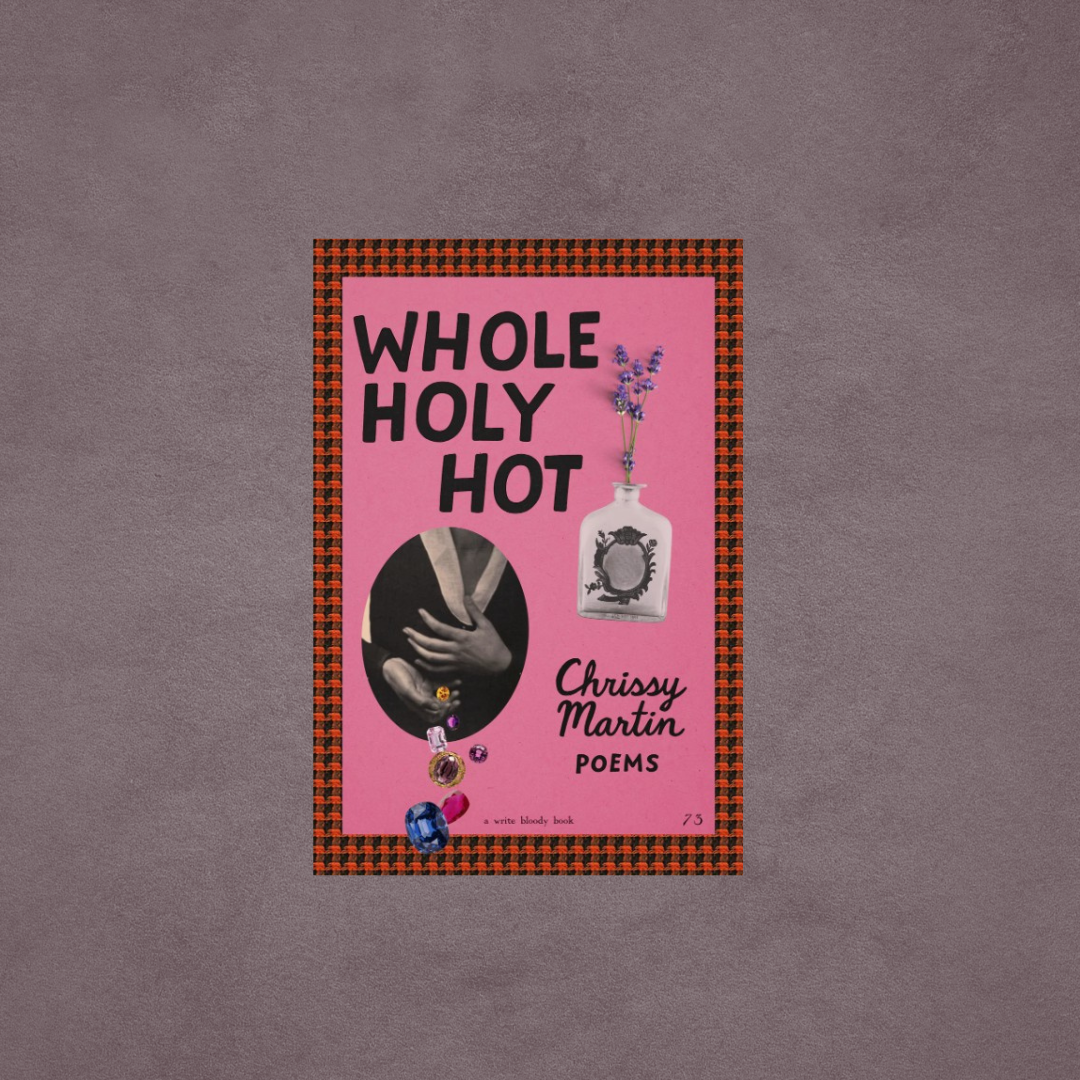
Don’t let the amusing opening quote by Paris Hilton dissuade you, Whole, Holy, Hot by Chrissy Martin is a fiercely intelligent poetic exposed photograph of living with mental and physical illness, medical-body-horror and loss, by way of pop culture homage.
Austin Poetry Review
Don’t let the amusing opening quote by Paris Hilton dissuade you, Whole, Holy, Hot by Chrissy Martin is a fiercely intelligent poetic exposed photograph of living with mental and physical illness, medical-body-horror and loss, by way of pop culture homage. It’s done in such a switchblade of formal verse, prose and gossip, with a simmering revolution cherry on top, it’s like reading the story of your own life at times, blurred with a heady contrast of classic and modern references from: RuPaul’s Drag Race, Germaine Greer, The Bachelor, Playboy and Adrienne Rich. All this, alongside the forming, burying and unearthing of a woman in a modern landscape, shaking stereotypes from her hair:
says my personality traits are symptoms. My
hardworking is overplanning. My empathy
is oversensitivity. My quick thinking is
overwhelming. Like conjoined twins, how
much do my illness and I share? Is it a thin clip
of elbow skin, or are we filling the same lungs? (Four-Week Follow-Up)
Rather than being dichotomous, it’s this deftly controlled sway from intensity, pain, humor and pith, that permits the reader greater accessibility, including the artful manner a woman not having children is shaped poetically, with the lines: “Will it believe if I say my life / is not a surrogate, but the thing itself?” Here, Martin lays bare the disparity between a world of children, and a woman without them, and all the contradictions this socially entails in her poem Enough. Or in Recomposition, with the lines: “I am so sick / of seeing my father’s body as dead.” Building to a purposing; that we are not ever, just a mere sum of our parts:
A whole person as heat,
as ash, as cinder. You should know there was not just pain
but pranks and joy and made-up songs. You should know
he had a laugh so booming his whole body shook,
syncopated like singing scales.
In the opening poem Laying Hands Martin equates, “begging for a missing limb,” her mother’s struggle to connect with Martin as a child, through the fog of antidepressants and migraines. From that indelible recognition of life betraying what we want, Martin is divining in her revealing of the ties that bind us to each other and ourselves; alongside the idea; “the power of choosing to believe.” By this, not simply faith, but believing what’s possible, but also, what is not and the power of perspective over reality.
[Egotism]
I am young and supposed
to be invincible. I am supposed
to be together—not misplacing
body parts like keys. There has
to be a reason everyone
on TV is twenty-five. (Upon Discovering There Is Too Much)
The vulnerability and honesty here is astounding. Rather than drowning, it provokes questions about existence and ‘trying everything’ to be well, alongside questions of physician assisted suicide and misplaced sexual desire in a bright misfiring mind and body. For those never sick, this may appear excessive. I can guarantee, anyone who’s been seriously ill, has once stood where Martin has and will appreciate the candor and community of her truth, with lines like: “You wake up filled with dread. There seems no reason for it.” And alongside this revealing, is something larger than a single person, it is the allegoric soul of this collection, speaking to all of us, which is why the poem that most stayed with me long after reading was the very last, Self-Soothing Exercise IV: Soul:
What has hurt me so terribly all my life until this moment
and what to do with my hands in the after. After lilac season
they’re junk, I mean detritus caught spinning in rough wind.
What’s left after the last purple scatter. Who am I without
the ache that kept me alive.
This isn’t purely about Martin, it’s a universal message, neither wholly hopeful, nor entirely despairing, the gentling edge of emotions, handled with such care, it seems impossible. Whether confronting the death of her father, or the raw sensuality of reaching for a loved one, or the comforting possession of disparate totems like clothes buttons, Martin repeatedly bundles human-experience into achingly lovely poetic footprints:
When I cry
about death, it is only in secret. This time, I want
to be seen. I tell you there is something delicious
about grieving where you might be discovered. (Privacy Settings)
In Some Like It Hot (a nod to the Monroe film of 1959 and the authors culture connoisseur status) the line: “Without diagnosis I am just a mystery,” is most poignant, as she goes on to say: “Mine is a sickness I won’t name. I am young; I am young;” Instead of being simply confessional and swerving into maudlin self-pity, which she has every right to; Martin uses disembodied meter and octaves, to figuratively feature mysterious ailments, both in pastiche and phrasal verb use, which is dexterous, in contrast to her own physical breakage. In disquieting and unapologetic revealing, Martin uses pornography, in her series Centerfolds (in individual poems) to discuss concepts of disability and desire. Don’t expect to feel easy in this expose, the intention is to highlight the sexuality of all people, not just able-bodied, and address the un-addressable, as ignored by society-en-mass:
She was a virgin before
the accident, studied every book about sex, learned every trick a tongue can do:
I wanted to make sure I could compete with the able-bodied women out there. (Centerfold ll)
Feeling uncomfortable forces us to ask why? And this is how we stop being shallow in our concepts of sexuality and disability, aside from the horror of the medical system in relation to women’s bodies, crescendoing toward the body-politic, which is examined bluntly:
the state I live in now sees my body
less target more argument (Colorblock)
I can imagine some criticizing the level of attention given to erased experiences, calling them; off-putting, too visceral. I expect this is exactly why Martin wrote this. Yes, it’s unpopular to talk of things we’re all doing our best to pretend can’t happen, but they can and they do. Martin’s first-hand experience is testament to the absurdity of head-in-the-sand-strategy. None of us can escape what might occur, and then, with disability, pain and unknown diagnosis, how do we go about living the rest of our lives? This is the crux of this collection, written by a woman who was faced with just that. Write Bloody Publishing’s moto being “poetry isn’t just read—it’s lived,” explains their appreciation of Martin’s memoir-in-poetry, as Martin’s writing is alive, not just printed, it becomes, rather than is, unfolding with each progression like music-score:
My dentist says: You bite your cheeks, my
nail technician: You pick at your hands, but
everyone is quiet when I say: Please tell me how
to stop. (Five Hundred-Day Follow-Up)
There is no conclusion here, only a temporality, inflecting through piano keys of loss, gain, loss. Skeptics could accuse this kind of poetry of reflecting grief, rather than solving it. A realist knows grief isn’t solved, it’s rubbed repeatedly until it becomes softer. Who among us hasn’t danced in its arms at least once? The skeptic can keep the opinion it’s not worth revisiting, I say, nothing is more necessary than mining the words that articulate things that cannot be said:
Teeth and all, we chose to burn him. We know
the bones stay behind with coffin nails and
steel hinges. Usually the hip bones and shin-
bones and most of all the young-person bones
hold up to the heat and flame and maybe
in this case the teeth, the tooth, dead
and resilient will have made it. (Ode To My Father’s Dead Tooth)
Candice Louisa Daquin, Managing Editor, Lit Fox Books. Consultant Editor, Queer Ink and Raw Earth Ink. Poetry Editor, Writers Resist, Tint Journal. Author, The Cruelty (FlowerSong Press, Fall 2025).