
The Visible Field
- Home
- The Visible Field
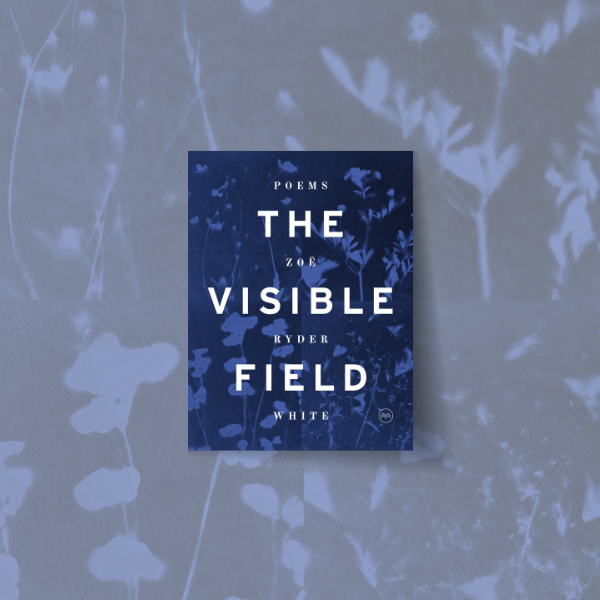
...one of those collections you will repeatedly return to and recommend... It burns around the edges, crackling with a shared energy we inhabit like thirst.
Austin Poetry Review
The Visible Field, by Zoë Ryder White
The Visible Field’s poems appear to seek that place between human internality and the inevitable exterior lives we must physically inhabit. Zoë Ryder White’s writing is at once, contemplative of this duality and able to extend through states of being. Perhaps this is achieved best in her focus on the small things that bring us joy and hope. In this, The Visible Field possesses a Zen heart, encouraging its readers to go beyond surface considerations, enabling us to inhabit her observations as if experiencing them first-hand. As in the line: “The shape of the body can be felt even if it cannot be seen.” In the poem ‘Interview’ toward the end of the collection, where language becomes movement:
I will take the pin from the hinge’s middle.
I will bury that in the hole that is for shouting into.
I will live by walking. Also by standing still.
The Visible Field, is poet Zoë Ryder White’s first full-length collection, published by River River Books and she’s rapidly growing her poetic pedigree; Her chapbook, Via Post, was a finalist for Tupelo Press’ Snowbound Chapbook award and won the Sixth Finch chapbook contest. HYPERSPACE was the editors’ choice for the Verse Tomaž Šalamun Prize and is (Factory Hollow Press). She co-authored A Study in Spring (Rabbit Catastrophe Press) and Elsewhere (Sixth Finch Press) with her close writing partner Nicole Callihan. Ryder White is a former elementary school teacher, who currently edits books for educators about the craft of teaching. In this collection, it is clear that she can wield language like a paintbrush:
I want to say I recognize everything, but I don’t, not even the house
moving across the yard lie a lit ship as I walk back from shutting in the hens. (Solstice)
The opening poem ‘Listen to yourself,’ is the outcome of a therapy session, where a query from the therapist turns into a walk-through nature. It evokes the understanding therapy is a tool for creative visualization, marrying the mind’s contemplations, alongside the physical experience within our bodies. When you do trauma work you learn as a therapist to pay attention to the reactions the body has, not just what is being said or heard. Often healing comes metaphysically through a series of journeys that could be described as surrealist. Ryder White grasps this early in the collection with the lines:
do you hear how you sound, she said
and I heard the sound of a mare
trying to turn around
in a stall too small for turning
The conversation between therapist and patient is intimate, the language feels close-by, this is furthered by the metaphor of a woman as a mare, in a confined stall. It speaks to experiences of confinement (pregnancy, gender, societal, inheritance) without naming them. There is more found in what is not said, through allegorical implications, and that stays as you read on. In ‘Jean, in the car,’ the use of commas, signify the literal pauses in language and meaning; the idea of children understanding death in different ways, of physical absence, of our own odd murmuring within and without:
Sometimes we go in, sometimes we go out. When we go in, the twins open their windows and stick their hands out.
The books’ title is an example of the link between Ryder White’s domestic life and the natural world outside, where she perceives and translates the corporeal with nature, by using ‘field’ to greater consideration of what we see, versus what we do not, because in looking closer, we can find more to be joyful for. This collection brought to mind the esoteric book ‘The Field: The Quest for the Secret Force of the Universe,’ an alternative-science metaphysical book by journalist Lynne McTaggart. Ryder White also explores the energetic vibrations that exist as a vast, interconnection, to all things in our world. If we imagine, the mind and the physical body are never separate but through a quantum physics lens, are perceived to be part of a ‘field’ where all living things exchange energy.
The dark in the box joined the dark in the hole
joined the dark the night made. My friend texts this world: ecliptic,
a noun, the great circle the earths’ orbit makes where it intersects
the celestial sphere. (Solstice)
The Visible Field exemplifies the idea of appreciating a moment, through to its completion, staying open for more, where you surprise yourself in what you experience when expanding how you are willing to be. Whilst there is imaginary, it is the connection of what we think with where we are physically, that enables us to relate to this imagined reality. There is deep satisfaction found, in the astonishment of what we didn’t notice. Often symbolic or imagined, language is removed from us, but The Visible Field considers the power of transformation, as acutely as any literal object; ultimately asking, what is real? Can physicality be certitude, just as symbolism is necessarily oblique? Or can we use our physicality as a map for the connection between the literal and the figurative, understanding both are necessary and neither are separate.
I’ll both fertilize and fuck up
your field. I’m here to remind you
you’re temporary, darling: (Nitrogen)
The analogy of a field, with grass seeds birthing literal life, the concept of a field of enquiry, where we can safely question concepts beyond and within us, becomes this ‘visible’ field, in a multidimensional way harnessed so acutely. White’s poetry is found in spaces between, where we can create room to examine the daily totems of existence, finding the extraordinary through the seemingly ordinary.
Because you watched throughout
the fullness of each moment you had set aside
for watching, you got to see a line bobcat exit the mist (Devotion)
There is a rich sense of physicality in response to. A purity then, of one’s response(s) in relation to the interconnectedness between self, body and nature. In the poem ‘The Emily Dickinson Divination Deck’ the lines decorate the mind’s eye:
Sometimes she’s silent on any subject.
I label it “deafening rebuke.”
The sky is blue in my throat again.
Windows bound in green.
Examine here, the language and color choices alongside abundant use of full stops. Each line punctuating the deeper reflection (earthly sadness) conjuring both Dickinson’s preoccupations, alongside Ryder White’s exhaustion of how to feel. There’s an electricity created between the two, which furthers the book’s themes of stepping outside of ones confines and joining somehow on a shared field where you can dream into existence. In ‘Room with Fan and Light Socket,’ which sounds like the title of a painting, (and perhaps it is in a way), she speaks to the states of feeling alone, parallel to the wild overgrowing fullness of nature:
Women asleep in apartments,
in beds alone, curled inside
a lover’s punctuation.
Inside the day, the dreaming, sun
on the late garden, light
The tempo and sensual rhythm of these lines underscore separation and inclusion which is both dichotomous and yet sensical in relation to ourselves. Using punctuation again to highlight what could otherwise be missed, querulous of whether the woman alone is truly alone, or just feeling so, whether a lover’s punctuation is admonishment, alienation, or misunderstanding? The natural world rushes unbidden around her poems, showering our senses with this idea of greater liberty, whilst our own corporeal selves are at times bound by our loss of potential (to be freer?). And then, lines like “we save up while we sleep” being a lovely interlude into another interpretation. There is a hypnotic underbelly here, one of intense hopefulness, remedying the everyday with flung arms, like the poem ‘Infrastructure’ where she writes:
It’s musical. Narcotic. Look,
I have tied a red-and-white bakery string
around my thumb, to remember this.
The simplicity of that observation, its sonic cadence and pace, ever moving, acknowledging the bright state of being we can experience in the oddest of moments, feels like it harks to Citizen Kane’s fondness for ‘Rosebud’ above all else, the enduring idea what matters is the experience of, not the value of, where the very ‘edges’ of land become a ‘synthesis’ to “walk through each other’s centers” (Letter Home from Halifax). Quite simply, Ryder White’s language and choice of observations, coupled with her development of themes, urging into hopefulness, enshrines The Visible Field as one of those collections you will repeatedly return to and recommend. It holds that shimmering implication of wisdom and truth like an improv dance. It burns around the edges, crackling with a shared energy we inhabit like thirst.
If I am trying to reach somewhere, if I am trying not to,
If something is conjured up. If a body forms,
Is it yours? Is it mine? If we’re talking about love.
If the axiom’s undone. Where are you? (Conditional)
Candice Louisa Daquin, Managing Editor, Lit Fox Books. Consultant Editor, Queer Ink and Raw Earth Ink. Poetry Editor, Writers Resist, Tint Journal. Author, The Cruelty (FlowerSong Press, Fall 2025).

