The Hour of God
- Home
- The Hour of God
"The Hour of God" conjures a voice imbued with many traditions and cultures, the sounds of other worlds rippling like song, with interspersed rhythmical colors rising and falling like variegated skirts rubbing against fruit.
Austin Poetry Review
The Hour of God
Winner of the Jayanta Mahapatra National Award for Literature, poet Vinita Agrawal’s writing distinguishes itself remarkably from the plethora of estimable Indian writers who write in English. This is an almost insurmountable task, given the innumerable, transcendent writings by Indian writers in both their origin languages and foreign. To master poetry in one language is a feat by itself, to write equal or exceed in another language is singular, yet it occurs with imposing frequency, where we find even greater insight: “The past, a breathing corpse.” (Balm). Vinita Agrawal’s writing explicitly attests that eminent writing in a gestalt of love, humor and truth, can unfold into a shared conscious space and in almost silent consideration, reinvent oneself in the most vulnerable part of poetic space:
“Bulbul, teach me
how to be the tree—
to bloom and break
and still know how to rise,” (Teach Me, Bulbul)
Where the dissonance of grieving, stepping through an intensely personal etymology of metaphysical expansion, opens an overlooked Pandora’s box and airs out our thirst for imagining what comes next. Vinita Agrawal’s writing pierces the “persistent light of renewal,” as evidenced from the first poem in the collection ‘Before the Ancestral Home’ where symbology and phonographic writing, open ‘The Hour of God’ with impressionistic curiology:
“a shadow lies without a source —
a narrow plinth dividing
what was mine from what was not.”
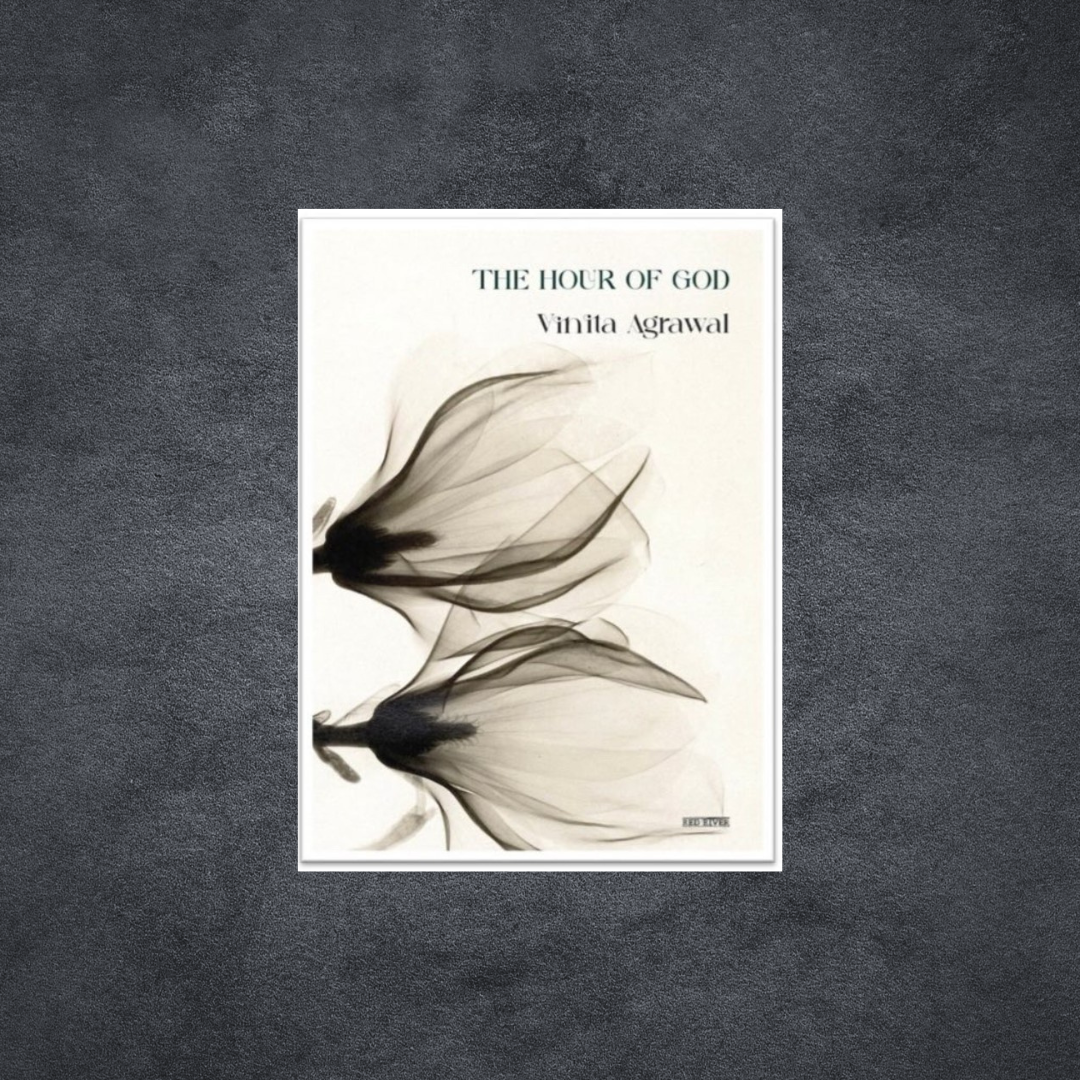
‘The Hour of God’ from its gently provoking title, to the opulent layout by Red River Press utilizing the stunning gelatin silver print artwork of ‘Branch of a flowering magnolia’ (1910-1925) and carrying it through the pages like wet ink, is a dexterous collection by a woman who undaunted, questions her core belonging and identity: “My reflection in a shop window, / a face out of place, a shadow among shadows / was it just the light of belonging refusing to settle on me?” (What If I Looked Beneath the A4 Sheet of Your Thoughts?). But how to explain why it hits so intensely? Is it the application of language? The temperament behind them? The rectitude or intentionality? Or the poignancy and pace of how the language is assigned and offered to the reader? It’s like looking at a beautiful face and trying to work out why it’s more beautiful than anything else you’ve seen. Perhaps it’s a sensation, a destined encounter or fated attraction? But something about Vinita Agrawal’s writing has landed this way every time I’ve read it and ‘The Hour of God’ is no exception, as in ‘Those Five Homes’ about her mother and the expanded concept of ‘home’:
“Your expanse over me
mint cucumber, curry leaves, aged basmati,
ambient, soft veils of scents
a magnet as strong as the poles”
In the second poem in the collection ‘Stroke’ it divulges its meaning but despite this seeming clarity, the way the words collect together, ushers a heightened painful memory of loss, which cuts deeply, also developing into beauty, with lines like: “a punch of darkness delivered to the solar plexus of a day.” This is both unnerving and poetry’s greatest bequeathment, to reflect something terribly sad, and access into a shared emotion with the backdrop natural pulchritude:
“Loss, a peepul tree, will take roots inside my chest.
For years it will grow — leaf by leaf. For years the earth will feel heavier.”
I thought of Judy Blume’s ‘Are you There God, it’s me Margaret,’ in the near eponymous poem ‘Is That You God?’ but Agrawal’s skin “of Indus mud / Vedic chants” (This Skin), is not that of a vapid Western teen, but entirely the opposite, a Hindu daughter, losing her parents, finding God’s message’s in sonic textures, lines holding weighted permanence like: “If there is a god of hunger, / a god of almost, / let me love what I cannot hold. / Let me starve.” (Let Me Love What I Cannot Hold). In the jugular of her mother’s home, emptied of her mother, Agrawal repairs her connection to God:
“That night when I unlocked the door
to an empty house, when loss palpitated
in the dark rooms and the parchment of grief
crackled in every molecule of air,
you came disguised as a whiff of mother’s perfume, God.”
These fractures cause you to flinch, they are not poems easily ingested, for any of us who have lost close loved ones. Agrawal knows this intimately with lines like: “Tell me, what do you call a love / that is unholdable?” (Unholdable Love). Yet, in poetry we find a way to reach others through the sharing of bruises, even as none of us want to examine that pain, it becomes an odd benediction of sorts, in the shared experience. I don’t say this lightly. These are poems that will dredge up loss like a colander without holes as they meditate on endings and identity. It’s challenging to face the unvarnished face of grief this way, where closure is elusive and one’s identity shifts repeatedly in uneasy symbiosis, but that’s without doubt what a poet is most capable of, where:
“O work that outlives the hand,
toil that outshines the myth,” (The Myth of Effortlessness).
Agrawal is artful in her rendering, to the point of accomplished language to describe agonies. She speaks of God without suffocating the reader in religious symbolism, because for her, God is everywhere, not simply a scripture or figurehead to refer to, and in this, ‘The Hour of God’ is both intensely spiritual whilst also staying close to its earthly origins, with lines like: “You were a lotus in my womb” (Ja), round in a perfect circle, reconciling us to what (stays alive) when we consider loss:
the runnels of grief
lie wide open on the floor.
How do I close the tap? (Hyoid Bone)
For a poet to be informed and select images and language that evoke, may appear the very staple of what poetry is, yet few dredge from the depths of their being, a synthesis in wording that urges discontinuity as an alternate tool to the masculine energies of linearity and choice of wordplay, that possess sufficient rendering of emotion and lived experience, to compel we not look away. Instead, these poems ask we enter the poetic-world of their creation, where we find ourselves in company with unguarded truisms, like the poem ‘Plea’ where the poet pleas that God spare us:
“from hollow words and hairline fractures in trust,
from the epidemic of apathy and dry analysis.”
It is within that omnitude where an adept poet or poem cultivates their strongest voice, and it is a marvel each time one is born, as they pray for us all:
“When stars lace my window at night,
remind me that I am the universe.” (Prayer)
Vinita Agrawal is one of few poets of any continent, I find are able to do this repeatedly and without artifice or giving away the magic behind their creations:
“Let me collect the numbers
you whispered to stars:
the price of rice,
the weight of my absence.” (Reparation to Mother)
Having grown up reading poetry in French and Spanish, I longed to experience poetry in Sanskrit, Arabic and Hindi, to fully comprehend which roots grow from cultivating words in logographic languages that have earned such a legacy in poetry-creation. The English language, crude and limiting, doesn’t have the refined edges of Arabic or Sanskrit, yet many Indian poets have managed to drag the hypnotic beauty and refinement of their origin vernacular into English. It is a form of sorcery I think, for how else to interpret why the exquisite Indian landscape and imagery is so redolent and potent when turned to English? I have long believed, merging the banality of English language with India’s panorama and cultural flavors, birthed a new language, one enhanced and more representative. Sometimes it misses the mark, perhaps too interior, but with a poet of prodigious poetic endowment, through lyrical precision and stark imagery, they can shine light on interiority in ways that access the poems like lotuses for the thirsty cranefly in us to drink from because:
“What is thirst
but love’s sharpest metaphor?” (Drought).
Agrawal’s deep compassion for animals and genuine love for nature, alongside the ambrosial artwork therein, as Agrawal explains, considering: “how this world changes us and is changed by us,” proffers a lavish journey to the very heart of existence and an intense interaction with the poet’s soul:
“The moon, a false martyr,
hangs a white plate
in the empty hallway,
offering solace to a long-numbed heart.” (Saying Goodbye to a Home)
To comprehend the intentionality of this collection deeper, the Hinduism outsider must be aware of certain specificities, to include knowing ‘Brahma Muhurta’ (the hour known as the Hour of God) as a “sacred stillness at daybreak.” This holy time period in Hinduism is considered auspicious for spiritual practice. Understanding another faith through the eyes of the beholder isn’t fully possible, but appreciating their spiritual journey, on a universalist level, may be. Agrawal’s poetry is an interplay between grief and renewal, which in her authors note she writes: “mirror the fractured nature of loss.” Many poems explore liminal spaces between endings and beginnings, that “Guard the Hour as a threshold.” (Guard the Hour of God) but often the readers reciprocity remains aloof, even as, “what you seek is seeking you.” (The Inner Syllable). Some ingredient found outside learning and linearity is needed to draw the reader closer. The only way this occurs is if the writing is both intentional and erudite, as well as authentic and pure; much like the process of practicing sacred stillness:
“I am the drop that echoes
in the cave’s black throat,
the salt that lingers
after the wave has gone.
I am the map of flame
a moth circles.
I am a prayer the glassblower
cannot shape.
I am what remains
when thirst is quenched.” (Concealed)
There are several distinct voices coming together to form an identity and elegiac signature. An evocatively female polemic of modern torment and self-inspection, rubbing against the mold of femininity and spirituality in the world so perspicaciously, it must only be read to be fully appreciated. ‘The Hour of God’ conjures a voice imbued with many traditions and cultures, the sounds of other worlds rippling like song, with interspersed rhythmical colors rising and falling like variegated skirts rubbing against fruit. In effort this cognoscente author makes such a feast of simplicity, that despite abundant literary skill, Vinita Agrawal’s finest voice is that most unadorned, such as in her love poem to a river:
“I wish I could run to you, Narmada.
Even from here…
Lash myself with familiar moisture
wild as the mulberries hanging low
over your flowing ripples.
As light-boned as the thrush skimming your waters.” (Narmada)
Candice Louisa Daquin, Managing Editor, Lit Fox Books. Consultant Editor, Queer Ink and Raw Earth Ink. Poetry Editor, Writers Resist, Tint Journal. Author, The Cruelty (FlowerSong Press, Fall 2025).