mother, daughter, augur
- Home
- mother, daughter, augur
She formats her world like a naturalist, going into the wild and gathering fallen totems like feathers and bones, to furnish into this uncompromising dreamscape.
Austin Poetry Review
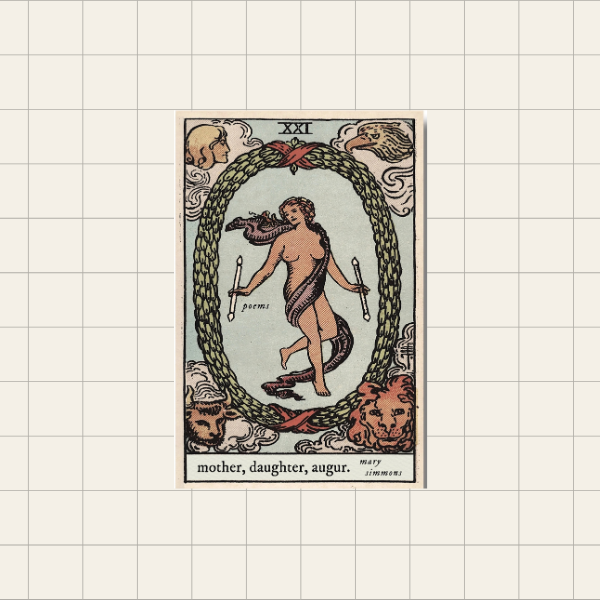
mother, daughter, augur. by Mary Simmons
Lit Fox Books is exceptionally proud of this kaleidoscopic winning manuscript in their first year of the Lit Fox Prize for a previously published collection of poetry. Even more astonishing, Mary Simmons’ Mother, Daughter, Augur, is her debut collection where she boldly dissects female inheritance and reveals the feverish pulse of this ritual-laden mythology in her sumptuously illustrated and designed collection published by June Road Press. The wonder of this collection is it never relinquishes into passive victimhood. Simmons debut is the loaming darkness of the female womb and fecundity, the richness of the very earth we stand on and the shadow places where women reinvent themselves when the outside world tries to confine them:
no one awake
to know if she lived. The earth softens, to be cloaked, to sing.
I sing with a throat full of fire. (Swan Maidens)
Based in Cleveland, Ohio, Mary Simmons as a queer poet, has multilayered tinges of herself alongside this ambitious riot of feminine myth and rebuke. Her poetry astonished the seasoned Lit Fox team who were unanimous about its brilliance. Mother, Daughter, Augur operates like an avant-garde, entomomancy-bright, bonfire, where the first flame struck in the dark, shines an unworldly light on the dark corners of trauma in relation to girlhood and folklore, alongside sharp subversive enjambment; visceral imagery and multiplicities of sensory juxtapositions that are both wonderous and sublimely crafted in lines like: “Let me anoint your forehead / with rose water, ghost daughter, yet to be born” (Woman at the Edge of the Woods). Simmons poetry is the semi-feral subversion of objectification, a kind of reworking of lore where the divine female is reclaimed, as if the singer Kate Bush had co-written with Psychologist Niomi Klein, a book of poetry, bursting with new symbolic magic and incantation:
When the forest goes dark, when wind
turns gauzy, when the moon is a tree
uprooted and snapped, look for me
under your footfalls. I’ve grown so tired. (Bedtime Story)
Often furnishing us with precise linguistic mechanics, acting at times like speculative matchboxes awaiting their fire, Simmons perceptively recognizes how we unconsciously house our ghosts. Writers may select to hide behind their language, or they come rushing through it. Simmons chooses fearlessly to light the stage and supplant oppression with the seat of unbridled female power: “as though my mother saying my eyes are green / makes my eyes green.” (Lullaby). There is a psychological landscape within her poetry in which a visceral feminine psyche builds a surrealist house of mirrors that are then haunted by Persephone, Eurydice, Ophelia, and Lot’s wife. These female ancestral archetypes Simmons turns to, by way of deeper understanding, enact the transformation occurring. She does this alongside the concept of women carrying each other through time physically and emotionally:
Each of us carries a ribboned bundle
of my death. Each of us mourns what grieving
mourns when grieving stops mourning
our flightless things. (Victorian Hair Jewelry)
Mother, Daughter, Augur, becomes a piercing reclaiming instrument that Simmons builds much like a temple, to her language and ultimate intention. She formats her world like a naturalist, going into the wild and gathering fallen totems like feathers and bones, to furnish into this uncompromising dreamscape. In the opening lines of the book, she establishes this liminal universe of totems by declaring: “Every good ghost story begins with a girl / in the dark.” At times, Mary Simmons operates surgically; utilizing poetic devices in the construction of her queer-feminist dreamscape, where the formality of structure, alongside this found-elements tree of creativity, both echo back the psychological weight of Mother, Daughter, Augur, ensuring that form and trauma are equally recognized.
I went down to the creek to find myself because where else
would I be, but the lightning bugs were all dark all sound
all next life when they should have been beautiful
And it’s not enough, carving this self from the spit of the world (Insomnia in a Blue Glass Bottle)
Experiencing Mary Simmons’ debut is as much about realizing the things we were taught to fear, are often the very tools required toward liberation. Simmons asks her readers to rethink traditional feminine expectations whilst not giving us a neatly tied resolution; instead, she reclaims the very female unsteady mess of lived experience and glorious experiencing of this, over the more patriarchy-themed clinical truth. In her piece ‘Firstborn,’ the speaker states with a guttural, raw lack of censorship: “I want. I want and I want and I bleed/persimmons.” The sheer intensity of this hungering is a testament to what it means to possess a body society constantly attempts to hollow out or institutionalize into compliance. In her poem; ‘When the Story Ends’ she addresses pain without the shame of pretending it doesn’t exist, a suppression that permeates our judgement laden society:
When it begins again,
there are absinthe-soaked branches,
there’s a confusion of bones.
There’s sun swollen with warblers,
and it will not hurt any less
Simmons’s language is exceptionally astute and considered; no word is misused or wrought merely for aesthetic shock value. In a manner reminiscent of Elizabeth Smart’s lush, fragmentary prose poetry, Mother, Daughter, Augur weaves domestic spaces with feral naturalism. In the poem where she tucks her ghosts in at night, providing them handfuls of snow instead of a bedtime story, she strips away the comforting illusions of the nuclear family or solace; “No, you will not pity me. / You will stand, in the rain, until the both of us have drowned” (Spindle). Her house is metaphorically heavy; the furnace covered with cobwebs. Here, death is not an ending, but a constant companion grazing the diviner. It is a stunning phenomenological study of what it means to be evicted from one’s own safety (or never possess it). Likewise, beginning with the lines “because we have always dreamed in poison” Simmons urges unsafety on like an unrelenting tsunami in her poem ‘Giulia Tofana’s Family Recipe’:
Because we eat cold ham at funerals.
Because goldfinches shot in the breast
bloom peonies. Because a plot of land
fits to the shape of her boot. Because autumn
tastes like fire, and this tastes of nothing at all
What strikes deepest into the marrow of Mother, Daughter, Augur is how it treats the relationships between women. The dichotomies of maiden, mother, witch, and lover are completely blurred. This is a contemporaneous queer lineage that rejects the old linear arcs of patriarchal storytelling. For example, in ‘Bedtime Story,’ the speaker addresses a longed-for daughter, the lesson is beautiful, terrifyingly uncensored lament:
Really, little one, this time you can open your eyes and the forest is still
the forest and you are not a little girl, you are
a wolf.
Here is the crux of Simmons’s universe. She does not offer her daughters a shield; she offers them a piece of physical body. She teaches the feminine soul to transform the concepts of its decay; its dead spiders, its rotting pears, its winter silences, into a fierce, enduring strength. The human being in these pages becomes indistinguishable from a downed tree, deeply rooted in the soil, absorbing the dampness of the earth until madness and metaphor comfortably share a seat. In this, Mother, Daughter, Augur is an essential, shimmering text for anyone who has ever felt silenced, anyone who has had to navigate the quagmire of institutional or familial betrayal, and anyone who still believes in the transformative, mystical power of the feminine voice. It is a collection that stays with you long after the final page is turned, burrowing deep into your subconscious, a kind of hypnagogic invocation. In her poem ‘self-portrait as the unexplained blurs in old landscape photography’ Simmons unites ideas of erasure and not belonging, alongside echoes of the male-written fall of Eve or Persephone:
And I drank
water from the tap cupped in both hands
and closed my eyes and knew I was not
a river, or a cajoling songbird, or a ghost
waiting to be loved again, or a girl, or a ribbon
on the breeze, or anything that would ever matter
beyond a whisper at dusk, a fragile little thing.
Simmons rejects typically passive metaphors that have been historically assigned in poetry to women. Her metaphors are unapologetic, wild, sometimes even grotesque. She forms feral metaphors in her staging of the human body, which is inextricably connected to the volatility of the natural world. Simmons does this by considering the eviction of selfhood, through the dissociation that comes from trauma in language like; “pond-swallowed, we do not recognize / ourselves”. She furthers these metaphors by imagining flesh in taxidermic terms, speaking to women’s performative roles within our bodies and the inhabitance of the female form as; “taxidermy / of blunted knives.” Even her line breaks can become weapons of sorts, to refuse easy assumptions. Simmons masterfully wields enjambment that creates periodic tension between the domestic and the predatory, dragging the reader across the white space of the page with a jarring emotional drop. Likewise, in her poem ‘Lake Once’ there is the feeling of a partial conversation, a reaching into the abyss:
Even if I hold my breath, I cannot hear
the water. My throat remembers winters
as a warbler, my feet the deer paths down
slopes of mud and branch, and I
can only reach for it in the wind.
In her careful juxtaposition of related language, Simmons often forces a suspension of identity for a moment, refusing any expectation from a reader, for some fairytale resolution. Her enjambments become the vehicle for transformation, for example, mimicking the sudden, sharp snapping of a jaw. The construction of these poems employs sensory images that contrast beauty with the macabre, which is redolent of Gothic traditions. The images therein are weighed with tactile and gustatory language that physically evoke hunger, cold, rot and endurance. The silence of Winter or taut moons of Autumn aren’t employed to simply furnish Mother, Daughter, Augur; they represent a structural architecture within the poetic mind of trauma and womanhood. In her poem ‘Entomomancy’ the internalization enables a feeling of unyielding, survival in this unvarnished reality, beginning with the lines: “It’s going to be a harsh winter. / I don’t question what remains,” and continuing into:
They scrutinize her lifeline, and Bridget smiles,
lets them back down to the earth, tells me
There are yet other ways of becoming, and still
it’s raining, so I believe her. I do.
In the poem ‘Firstborn,’ there is the line; “I want. I want and I want and I bleed/persimmons” which touches upon a very specific heavy imagery of fruit, where the verb ‘bleed’ collides with the bitter flesh of the persimmon, which feels like a poetic letting of desire into a physical stain, become wound. Simmons paints domestic scenes that echo a sense of neglect and haunting, where; “lilacs into my hair and cobwebs across the furnace.” The proximity of dead dust in the cobweb furthers imagery to reflect the relationship between love and decay, in a psychological sense. Simmons’ ability to work with the macabre is exceptionally deft, she understands how poetic devices can be written to execute a textuality and ultimate function in exploring themes without losing the beauty of her language or the attention of her readership:
I’ve spent too few nights with the lights on.
Sometimes the forest is just a forest
and the trees are just women
baring their teeth (On Morality Tales)
In terms of structure, Mother, Daughter, Augur possesses a style of ‘anti-closure’ which rejects the traditional poetic ‘volta’ or classic turning point of resolution in poems. Simmons retains the tension and throws out our expectation, to evidence a more realistic hanging tension, sometimes mid-breath. Her language feels more dissolving, rejective of label, expanding silence. The structural formatting of her collection mirrors this non-linear lack of resolution which speaks to the truth of living with trauma:
The body is not a body unless each lost thing begets another.
Pruning is prayer in the dawn. My collarbone—impressions
in damp earth. Blooming, a strange carillon (The Valley of Tears)
When we contemplate the arc that Simmons collection takes; we find she holds the collection open as a witnessing to her act of structural dismantling. Since the tradition of poetry has historically relied upon the passivity of the female, such women were often two dimensional and Simmons sets a fire beneath these hollow poppets, in her reimagining of classical tragic heroines. Her goal? To lay bare the male gaze and subvert it through survival:
In the last winter, she prayed to be named, to be seen and collected
and etched into some lasting place. She let her gardens sprawl,
let her clay daughters shore up what she had planted
for a goddess. She let a universe populate itself with growing, (Clay Mother)
Examples of this include Shakespeare’s Ophelia, the ultimate ‘mad suicidal woman,’ as viewed through a traditional patriarchal lens. Ophelia’s compliance to stereotype is subverted, rather than gently dying in a thin river of flowers (and the disgusting romanticism of her dead form forever immortalized in pre-Raphaelite paintings afterward). Mother, Daughter, Augur achieves this by deliberate subversion of such cliches of (female) tragedy, dragging Ophelia out of this ‘decorative brook’ and throwing her into the mud. In her poem ‘I Tuck the Ghosts in at Night,’ Simmons doesn’t present death as a beautiful scene, but rather, a violent, awakened creature that feels physical and heavy:
I have forgotten what it means
to be alone, to sleep without
death grazing my palm
The feminist principle here, is concepts of madness reclaimed, whereby ‘mad’ isn’t seen as a weak collapse, but the weighted psychological response to being evicted from one’s self, a kind of reclaiming into solidity and wholeness. Likewise, when contemplating Persephone’s mythology, Simmons rejects the victimhood and ideas of ‘needing rescuing’ by reimagining Persephone through a queer lens, with themes of trauma and personal agency. In the poem ‘Firstborn’ the speaker demands: “I want. I want and I want and I bleed / persimmons,” This essential subverting of Underworld totems hands the power to the speaker. There is no Garden of Eden allusion where the fruit is a trick played upon a woman. It is a more deliberate, conscious and unbridled hungering; which breaks the censorship of such mythology and tells us, Persephone isn’t waiting to be rescued, she’s not imprisoned, she’s learning about her own power. Like Jung said, she’s inheriting her shadow self, freed of patriarchal surveillance.
It’s raining, and the crows
are little scorched things, burnt
all the way through. This is what home
means when home is a sunspot
waving over the field. When we’re gone,
we’ll love more. We’ll have more to lose (Our Trespasses)
When writing of Eurydice and Lot’s wife, Simmons rejects the historical stereotype of actions causing death, (and the theme of being punished for ‘disobeying’ a patriarchal mandate) in favorite of a more vital fury. Using Irish paganism as a root, Mother, Daughter, Augur returns to a pre-Christian landscape, where women inherit their power instead of ancestral grief: “Let me flood this hollowness with the voices / of mud women,” (Clay Mother). Simmons’ reimagined women are seeking truth in looking back, not regret. They are not punished for weakness but choose to know and own their history without banishment or censor: “The night can never be / as alive as you. This is a ghost story. / This is a love story.” (Witches in Love). In Mother, Daughter, Augur, Simmons creates an astonishing psychological depth by refuting the perceived discrepancies between gender and history. Her understanding of nature isn’t a passive backdrop of admonishment, it’s the mirror, the embodiment of resistance and resilience. Her intertwining of this animistic landscape, set against more modern spaces, reclaims the erasure or subjugation of women throughout history:
The goldfinches are returning. You’ve cut
your hair again. When it rains, tell me we grow
back the feathers we were born with.
Tell me all good stories end like this.
Can you see the stars where you are?
My winter swells with fog and light (That Steady Ache)
The brilliance of the collection lies in how Simmons drags these massive, archetypal mythologies onto a stage where we vanquish their male-gaze and reform them into the grand legends they always were and this is set against the intimate, subversive spaces of queer domesticity and unrepentant unearthed lineages of women: “Mothers pour our name into the hair of daughters / while they sleep, and a fire crackles.” (Dust of the Wilis). Whilst we recall domesticity was once an indentured trap for women, when we step outside the heterosexuality of domesticity, it is freed to become a new stage:
Daughters come to the woods as birds,
and I for their sacrament (Oscines).
Mother, Daughter, Augur’s home isn’t a suburban trap, it is a strange twilight sanctuary, where her speaker tucks ghosts in at night, feeding them handfuls of snow, or watches the lilacs intertwine with the cobwebs on her furnace. By so doing, Simmons reworks what it means to make a home. This is an empowered, female-infused domesticity, refusing to tidy its edges; instead beckoning the wildness of the forest inside itself:
When the roses died, the larks died, and the lake
overflowed, and the rain wouldn’t stop, and the wind
told me she loved me, but she lied, and I ran
blind between the trees. (Spindle)
By her placement of known formerly oppressed figures like Persephone or Ophelia inside this concept of home, Simmons connects us intimately with the power and totem of these women, rejecting the tragedy of them. This re-contextualization becomes a new palimpsest rhythm and history, asking modern trauma survivors to look at their trauma differently: “I thought by sewing my fear / into a quilt square, I could numb myself / through the winter” (Patchwork) not as a victim, but a survivor. Inheriting history not as an oppression, but a refreshed journey. The regenerating home in Mother, Daughter, Augur is woven into a radical sanctuary; permitting the reclamation of memory, rejecting the idea madness is weakness, even asking us ultimately, whether we need to be cured? Or instead, can we reject this patriarchal idea of ‘fixing her’ and just BE.
no one awake
to know if she lived. The earth softens, to be cloaked, to sing.
I sing with a throat full of fire. (Crucible)
Candice Louisa Daquin, Managing Editor, Lit Fox Books. Consultant Editor, Queer Ink and Raw Earth Ink. Poetry Editor, Writers Resist, Tint Journal. Author, The Cruelty (FlowerSong Press, Fall 2025).