A Film In Which I Play Everyone
- Home
- A Film In Which I Play Everyone
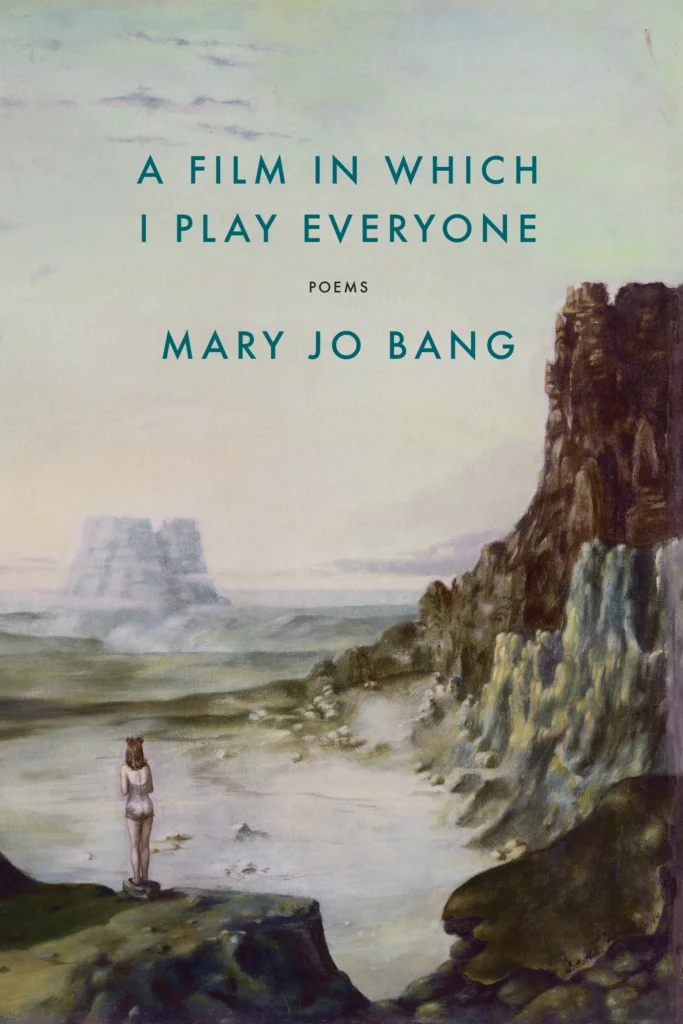
Bang’s latest book boldly explores the cast, crew, and setting of her mental universe.
Rebekah Teller
Playing Everyone
Mary Jo Bang is an artist of many avenues. She has degrees in sociology, photography, and creative writing (“Mary Jo Bang | Poetry Foundation”). Her broad base of experience and study gives her poetry rich depth of layers. Throughout her work, she experiments with melding the inner world and the outer world to showcase a private, individual universe.
In an interview with Lynn Strongin, Bang elaborates on this while talking about being shy and emotionally hypervigilant of others as a child. “In order to escape my situation, and at times myself, I think I learned a form of dissociation where I could split my mind and enter a parallel universe, that of a book or a fantasy. Later, when I became a writer, I saw that being observant, of others, of myself, of the physical world, was actually something that could be useful in terms of constructing the universe of the poem.” There’s something about being silenced at an early age that teaches one to do that.
Bang’s latest book, A Film In Which I Play Everyone, boldly explores the cast, crew, and setting of her mental universe.
In this collection, the poem “Our Evening is Over Us” directly addresses this concept with the lines: “There is // no getting around the fact that each of us is / a world of our own. An entity. A pageant / of one” (Bang).
Several pieces in A Film are in the confessional vein of Anne Sexton. For example, in “Her Kind” by Sexton, the first-person narrator shows us a variety of women she has been, can be, and relates to in an unapologetic way. Bang uses a similar point-of-view technique throughout A Film.
She describes this shifting perspective in an interview with Mandana Chaffa, “Those ‘characters’ … they’re all in my memory bank,” Bang said. “Each was cued as I was writing and I either put it in a poem, or else mentioned it later in the notes.” (Chaffa)
The title of the collection is inspired by a quote from David Bowie. Bang uses the umbrella metaphor of a film throughout the book, with pieces that reference cameras, stage, curtains, sets. This metaphor serves as a framework for the changing perspectives and facilitates an open-mindedness in the reader. Bang stated, “I think it’s helpful to act as a camera, one which oscillates, moving out to see the world (even if it’s a purely imagined world) and then moving in to see the self (even if it’s a purely imagined self).” (Chaffa)
The poem “Some Identical Twin Sister, One Step Ahead” expressly looks at this quandary of perspective. “You have to be a seer to see. / What you really want is to be a camera, / documenting the height you’re about to fall from.” (Bang)
Like Bang, I’m also from Missouri, which is a unique realm on its own. Predominately covered by the Ozark Mountains, the region is populated by cliffs and valleys, winding rivers and curvy roads. Flooding is a problem every year. When you grow up in the Ozarks, you learn that you can’t see very far ahead of you, and the road itself can be swept away. The dangers of limited visibility are ingrained in the upbringing of a Missourian.
Changing perspectives and changing characters is a relatable metaphor for individuals who grew up in emotionally abusive environments, where fawning, people-pleasing, and shutting down personal wants and needs are necessary survival skills.
Bang also explores emotional triggers and skipping through time with memories. In “Children Were Erasing Their Faces” the present scene is at a party, the narrarator having a conversation with an adult man, while bits of visual observations or sounds jerk her through traumatic memories and back to the party seamlessly. The effect works well, as if the reader is watching a movie that cuts to flashbacks.
In “What I’m Covering Over” she takes a deeper look at this issue of memories.
What I’m Covering Over
is the seething beginning
where I saw things but didn’t know
what they meant.
Bang draws from literary references and mythology that allows for a similar process of reexamining story and searching for truth. In “Here We All Are With Daphne,” she challenges the version of the myth of Apollo and Daphne that has lasted this long. It feels somber and haunting.
a man turned me into a tree. “See,” he said.
“isn’t this all for the better? You with no mouth
to speak of?” By you he meant me.
She further explores the theme of being silenced in “A Set Sketched by Light and Sound,” for example in the lines, “An alarm that tells // of the need to absent yourself, to lie down / and behave as if you have no agency” (Bang). And in the titular poem, she writes “You’re an extra. That day you were filmed // on the steps walking into the school dance, / the costume you wore was pure you.”
The struggle of finding identity also comes up in the poem “Hotel Incognito”:
I was going through the motions of deciding
I didn’t belong, not then, not there, not anywhere.
As a woman who struggles with voice and identity, feeling silenced and trying to tell my story, the recurring themes in A Film resonated with me deeply. Flipping through memories, piecing together storylines, trying to understand who I am by understanding the past I came from, it’s a universal experience survivors go through. Alongside that is a crippling sense of feeling alone and misunderstood.
A Film serves as a lighthouse for anyone struggling with these issues. Bang reveals to us her mission through one line in the titular poem, a heartbreaking line that resonates with readers: “I’m making sense all the time of all the senseless endings.” In her interview with Chaffa, she describes writing poetry as her medium for this endeavor. “I never know where I’m going when I set out to write a poem,” Bang said. “The poem becomes a language map of where my thinking takes me.” (Chaffa)
Works Cited
“Mary Jo Bang | Poetry Foundation.” Poetry Foundation, www.poetryfoundation.org/poets/mary-jo-bang. Accessed 19 November 2023.
Bang, Mary Jo. A Film in Which I Play Everyone. Graywolf Press, 2023.
Sexton, Anne. “Her Kind.” The Penguin Anthology of Twentieth-century American Poetry. Rita Dove. Penguin Group USA, 2011, pg 287.
Chaffa, Mandana. “‘Speaking Is A Way of Living With The Ruin We Were Given’: A Conversation With Mary Jo Bang.” Chicago Review of Books, chireviewofbooks.com/2023/09/14/80359/. Accessed 3 December 2023.
Strongin, Lynne. “Notes from the Phantom Realm: Mary Jo Bang Interviewed by Lynn Strongin.” Poetry Society of America, poetrysociety.org/poems-essays/interviews/notes-from-the-phantom-realm-mary-jo-bang-interviewed-by-lynn-strongin. Accessed 3 December 2023.
Rebekah Teller earned an MFA in Writing at Lindenwood University and works as a copywriter. Her poetry has been published in Red Ogre Review and she wrote a series of poetry books called Flowing in the Trenches. She lives in the Ozarks in Missouri with her husband, two teenagers, and three dogs.